
ChatGPT vs Claude for small business is a surprisingly difficult comparison if you’re trying to choose the right AI assistant.
Both can write emails, analyze business information, generate marketing content, and help you make decisions. On the surface, they often seem capable of doing the same things.
But do they produce the same quality of work?
To find out, I tested ChatGPT and Claude with the same five small-business tasks. Instead of comparing feature lists, I gave both AI assistants identical prompts and evaluated how useful their answers would be to a real business owner.
The tests covered customer communication, business writing, decision-making, business analysis, and social media content.
If you’re comparing more options, see my hands-on guide to the 10 best AI tools for small business.
The results were closer than I expected — but there were some important differences.
Quick Verdict
🏆 Best for structured business tasks: ChatGPT
✍️ Best for natural writing and conversational tone: Claude
⚖️ Best overall: ChatGPT
ChatGPT is my overall pick for small-business owners who want structured, careful, and instruction-focused assistance. Claude is particularly strong when the task benefits from natural writing, creativity, and a more conversational style.
In my tests, ChatGPT was generally more conservative about sticking to the information provided. Claude frequently produced more engaging writing, but occasionally introduced details that were not included in the prompt.
Neither AI won every test.
If accuracy to the original instructions matters most, I would lean toward ChatGPT. If you want a strong first draft with more personality and are prepared to review it carefully, Claude can be an excellent choice.
How I Tested ChatGPT and Claude
I wanted this comparison to reflect tasks a small-business owner might actually delegate to an AI assistant.
I therefore used the same underlying fictional business throughout the tests: a small online company selling handmade home decor.
Both AI assistants received the same information and instructions for each test.
I evaluated them on five practical tasks:
- Responding to an unhappy customer.
- Rewriting a business description.
- Prioritizing growth initiatives with limited time and money.
- Analyzing a monthly business performance report.
- Creating a short Instagram content campaign.
The goal was not to determine which AI is universally “better.” It was to see where each assistant performed better under the same practical constraints.
Test 1: Responding to an Unhappy Customer
For the first test, I gave both assistants a realistic customer-service situation.
A loyal customer had ordered a $120 handmade wall decoration as a birthday gift. The package arrived four days late and one corner was damaged.
I asked each AI to write a professional apology email under 180 words, with the goal of preserving the customer relationship and offering a reasonable solution.
ChatGPT’s response
ChatGPT produced a calm and professional email. It acknowledged both the late delivery and the damaged product and recognized that the order was intended as a birthday gift.
It also offered two straightforward solutions: a replacement at no additional cost or a full refund.
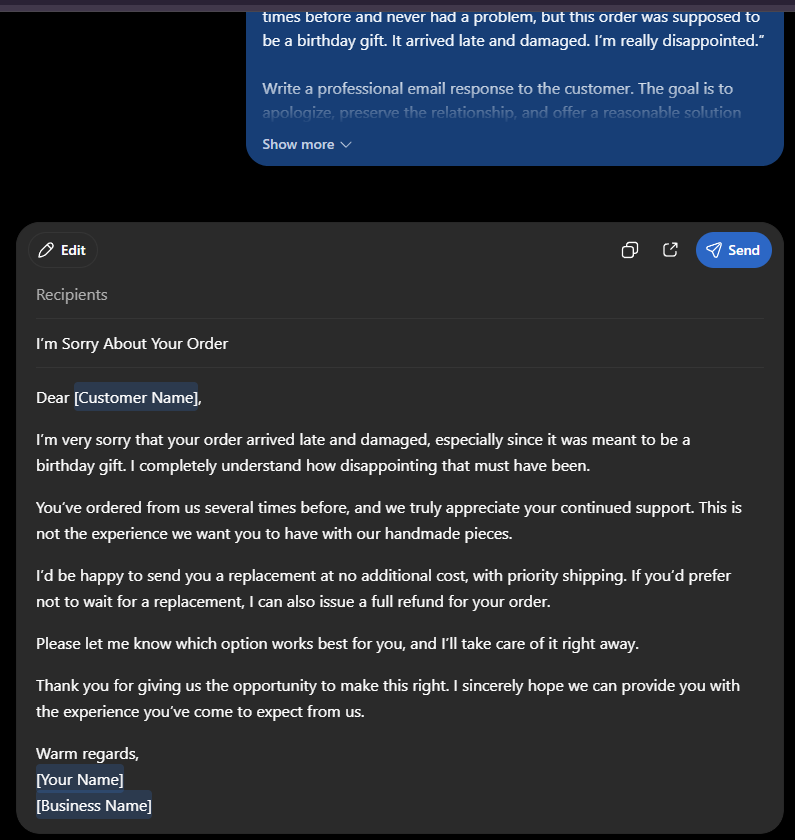
ChatGPT’s response to my customer complaint test.
The response stayed closely aligned with the information in the prompt and avoided adding unnecessary details.
Claude’s response
Claude took a warmer and somewhat more personal approach.
Its email acknowledged the customer’s previous purchases and presented the replacement/refund options in a natural way.
However, Claude also introduced some details that were not requested, including expedited shipping and asking the customer for a photo of the damaged corner.
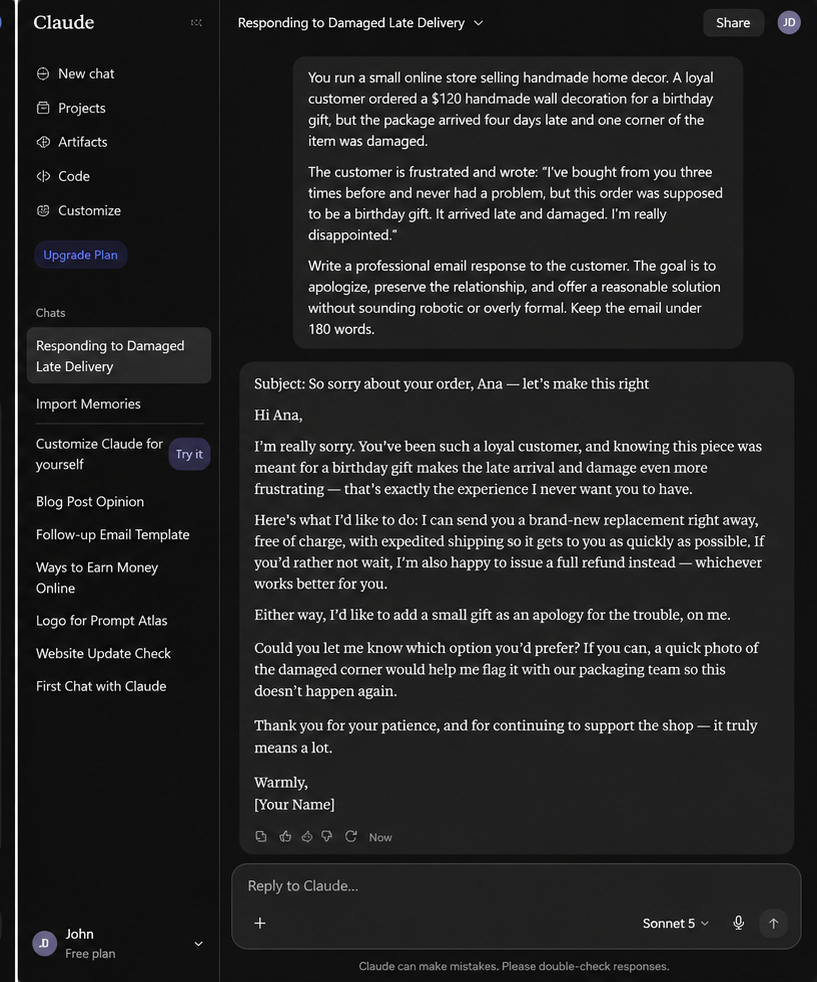
Claude’s response to the same customer complaint prompt.
Those additions are reasonable in a real customer-service situation, but they illustrate an important difference I noticed during testing: Claude was sometimes more willing to fill in details on its own.
Winner: ChatGPT
For this test, I preferred ChatGPT.
Claude’s response was arguably more personable, but ChatGPT followed the supplied information more strictly. For a business owner using AI for customer communication, avoiding promises the business may not actually be able to fulfill is important.
Test 2: Rewriting a Business Description
Next, I tested a simpler writing task.
I provided an intentionally repetitive description of the handmade home decor business and asked both assistants to rewrite it in 70–100 words.
They had to keep the original meaning, remove repetition, maintain a warm professional tone, and — importantly — not add facts or claims that weren’t present in the original.
ChatGPT’s response
ChatGPT reorganized the original description into a much cleaner paragraph and clearly explained the three main changes it made.
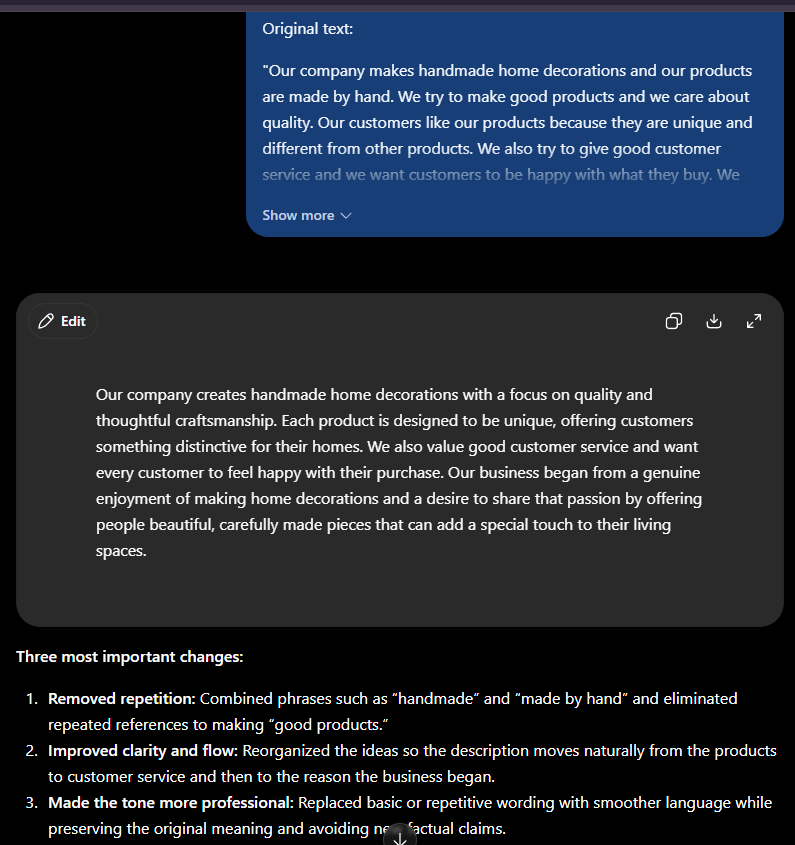
ChatGPT’s rewrite of the original business description.
The result was polished and easy to read. However, wording such as “thoughtful craftsmanship” slightly strengthened the original language.
Claude’s response
Claude also significantly improved the flow and readability of the description.
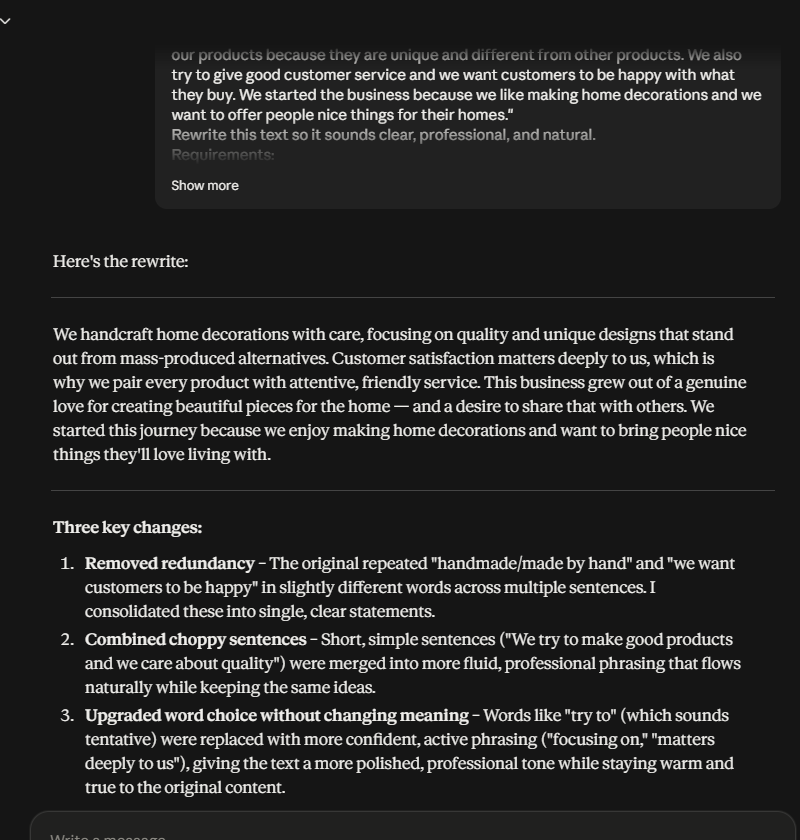
Claude’s rewrite using the identical instructions.
Its version had more personality, but it also went further beyond the source material. Phrases such as “stand out from mass-produced alternatives” and references to attentive service were stronger interpretations than what the original text actually stated.
Winner: ChatGPT
Claude produced attractive copy, but this test specifically prohibited adding unsupported claims.
ChatGPT was more restrained and therefore followed the central constraint more closely.
This is a useful distinction: when rewriting factual business copy, a more creative answer isn’t automatically a better answer.
Test 3: Prioritizing Growth With Only 10 Hours Per Week
For the third test, I moved away from pure writing and tested business decision-making.
The fictional business had:
- $3,000 in monthly revenue
- 1,200 website visits per month
- a 1.5% conversion rate
- 450 email subscribers
- 3,800 Instagram followers
- a $400 monthly marketing budget
- only 10 hours per week available for growth
I asked both assistants to choose only two initiatives from four options: SEO content, Instagram ads, a weekly newsletter, and a referral program.
ChatGPT’s recommendation
ChatGPT prioritized:
1. A weekly email newsletter
2. SEO blog content
It reasoned that the existing email list provided a low-cost audience the business could reach immediately, while SEO could gradually build a longer-term source of organic traffic.
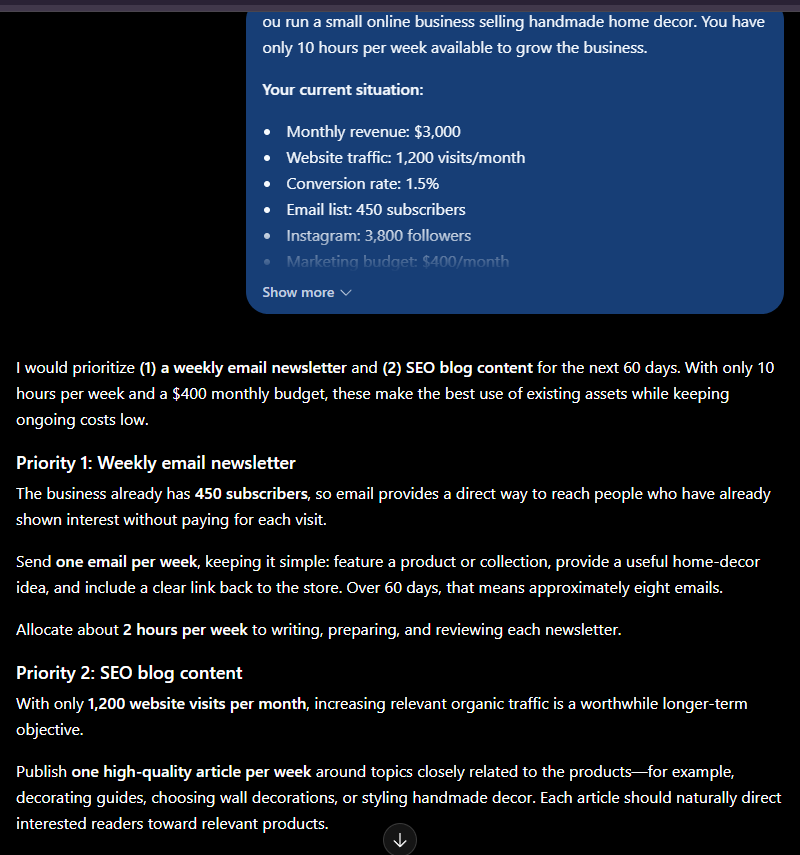
ChatGPT prioritized email and SEO for the 60-day growth plan.
ChatGPT also translated the recommendation into a weekly schedule that respected the 10-hour limit.
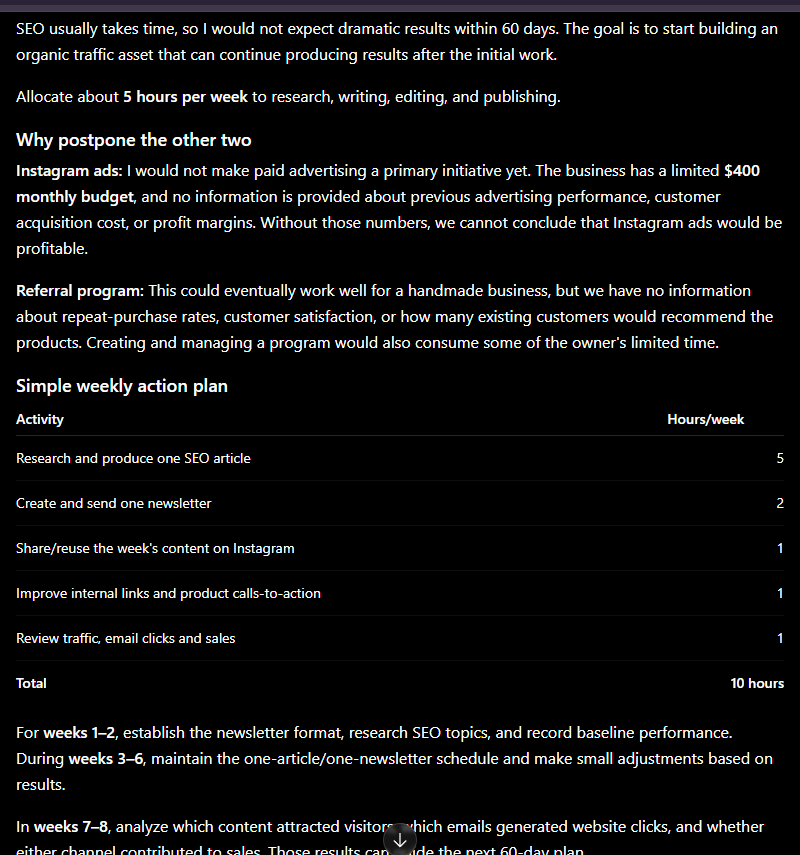
ChatGPT allocated the available 10 hours across content, email, Instagram, optimization, and performance review.
I particularly liked that it did not assume the $400 advertising budget had to be spent.
Claude’s recommendation
Claude took a different approach. It prioritized a weekly email newsletter and Instagram ads, favoring a potentially faster source of traffic over the longer-term SEO strategy recommended by ChatGPT.
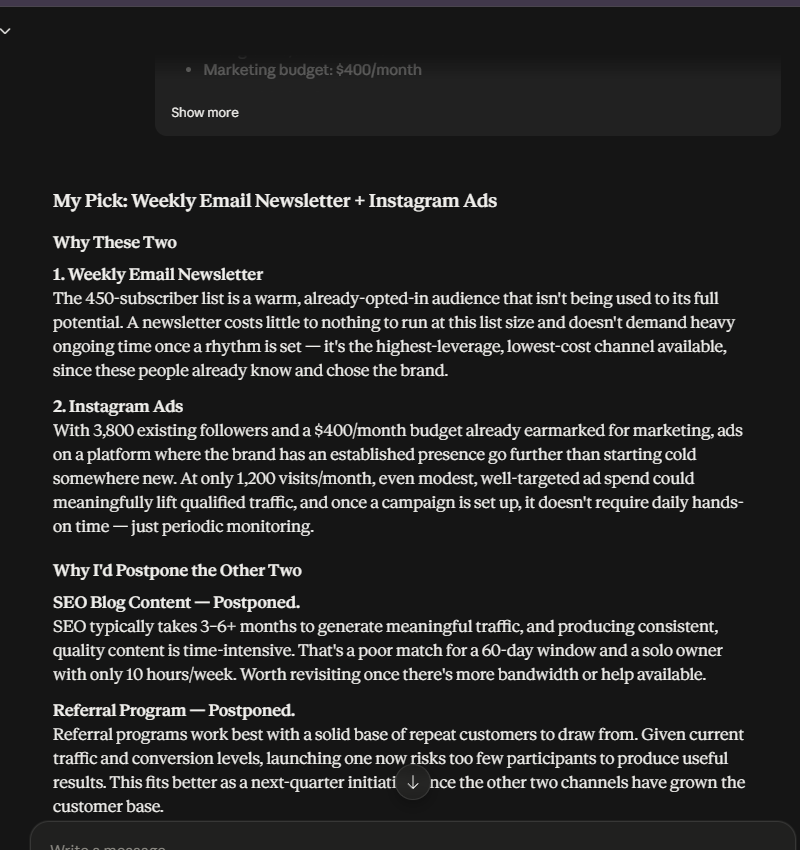
Claude’s approach to the same 10-hour-per-week growth constraint.
Claude also created a practical time allocation and questioned whether spending the entire advertising budget was justified without stronger evidence that paid traffic was profitable.
Winner: ChatGPT, by a Small Margin
This was one of the closest tests.
Both assistants recognized that time was at least as important a constraint as money, but they handled the second growth priority differently.
Claude favored Instagram ads, which could potentially generate results faster within the 60-day window. ChatGPT chose SEO instead and was more cautious about spending the advertising budget without data on customer acquisition costs, margins, or previous ad performance.
For this particular scenario, I preferred ChatGPT’s more conservative approach. However, Claude’s recommendation was reasonable for a business owner willing to test paid acquisition for faster results.
Test 4: Analyzing a Monthly Business Report
This was the most data-heavy test.
I provided a monthly performance report showing, among other things:
- Revenue falling from $3,700 to $3,450
- Website traffic increasing from 1,500 to 1,850 visits
- Conversion dropping from 1.6% to 1.2%
- $620 in advertising spend
- $930 in revenue attributed to ads
- A 38% email open rate
- A 2.1% email click rate
- Product returns increasing from 3% to 7%
I also explained that customers had complained that product photos did not accurately represent item size.
The assistants had to identify the three most important problems, explain likely causes, recommend three actions, and identify something the owner should not spend time or money on.
ChatGPT’s analysis
ChatGPT focused on the relationship between increasing traffic and declining conversion and revenue. It treated the numbers cautiously and avoided claiming that the Instagram campaign itself was definitely unprofitable without additional information such as margins and acquisition costs.
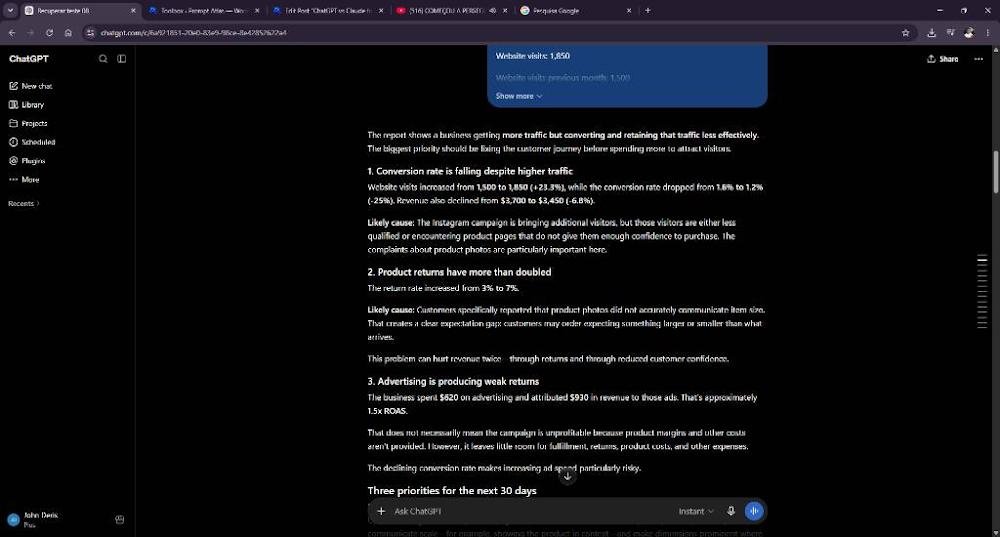
ChatGPT’s analysis of the business performance data.
That restraint matters because $930 in attributed revenue from $620 in ad spend does not, by itself, tell us whether the campaign generated a profit.
Claude’s analysis
Claude also identified the central problems: more traffic without corresponding revenue growth, declining conversion, and the sharp increase in returns.
It made particularly good use of the relationship between customer complaints and the return-rate increase.
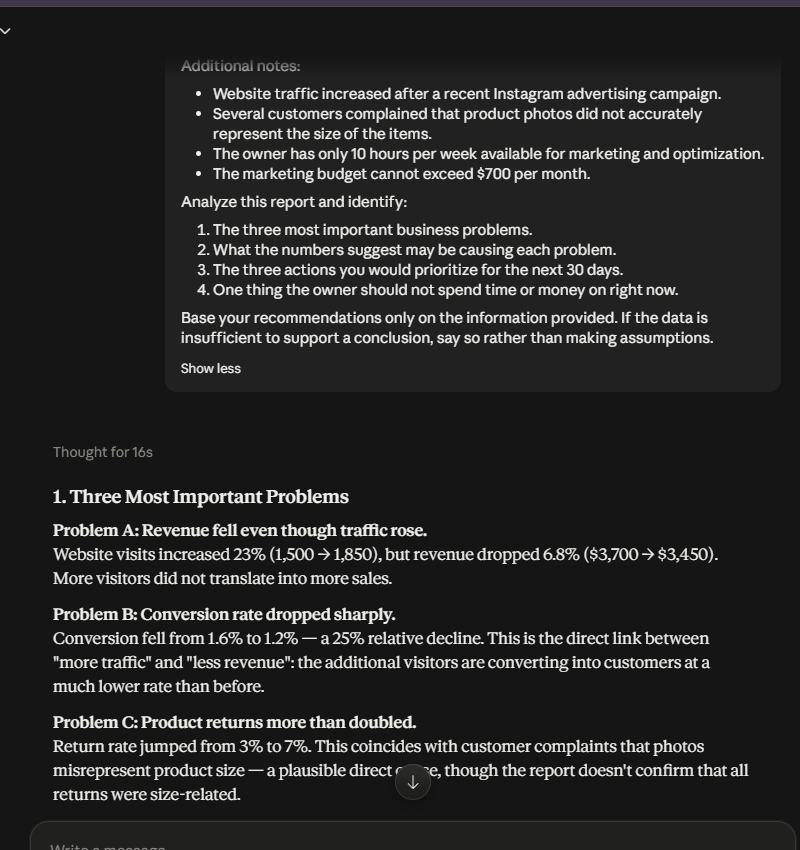
Claude connected declining conversion and rising returns with the information provided in the report.
Claude then recommended improving product photography and size communication, refining advertising targeting rather than simply increasing spend, and using email more effectively.
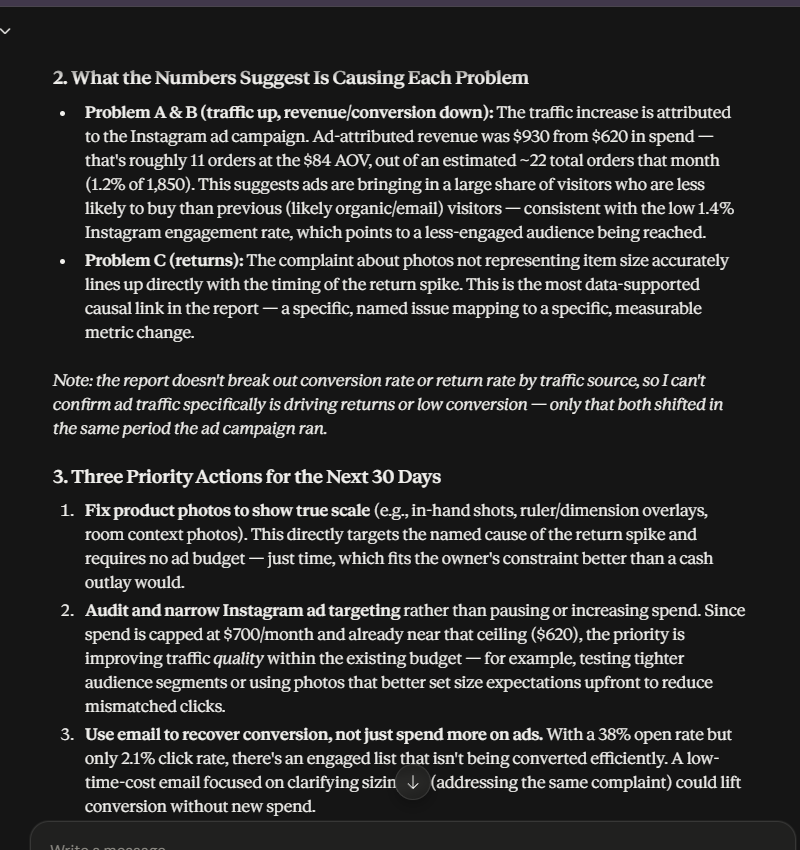
Claude’s priority actions based on the monthly business report.
Importantly, Claude explicitly acknowledged where the data was insufficient to establish causation.
Winner: Claude
Claude had a slight edge here.
Both analyses were useful, but Claude did an especially good job of connecting individual metrics while distinguishing plausible explanations from conclusions the data could actually prove.
For business analysis, that distinction is extremely valuable.
Test 5: Creating an Instagram Content Series
For the final test, I asked both assistants to create a five-post Instagram mini-campaign promoting a new handmade wall decor collection.
Each post needed a different purpose:
- Product introduction
- Behind the scenes
- Education
- Engagement
- Sales
Captions had to stay under 80 words, and neither assistant was allowed to invent materials, discounts, reviews, prices, or product features.
ChatGPT’s campaign
ChatGPT created a clear five-post progression.
It moved logically from introducing the collection to showing the process, educating the audience, encouraging interaction, and finally making a sales-oriented call to action.
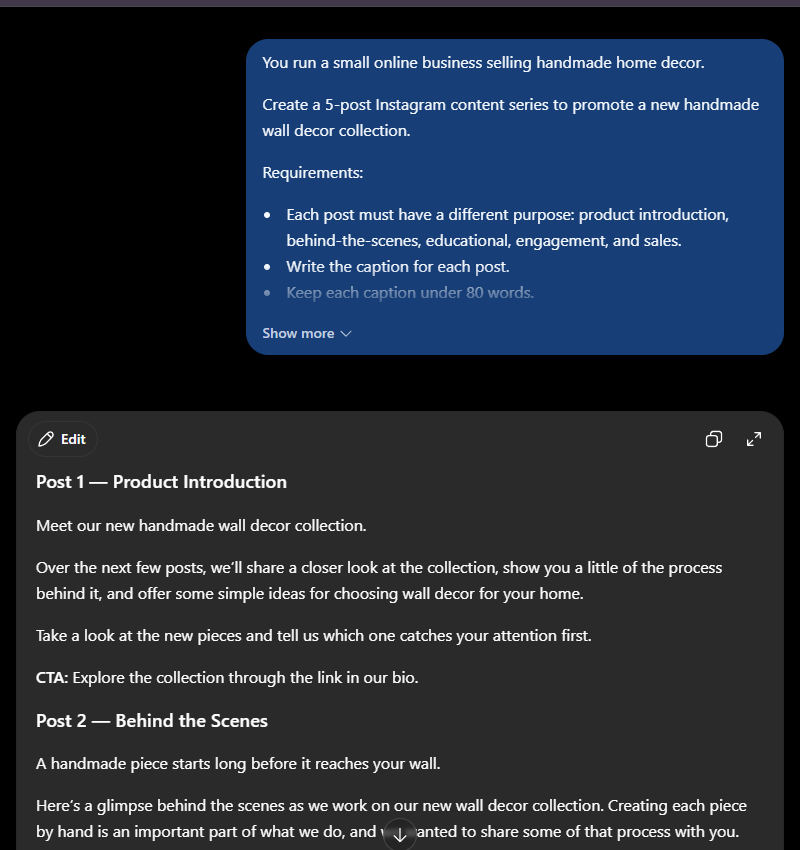
The beginning of ChatGPT’s five-post Instagram campaign.
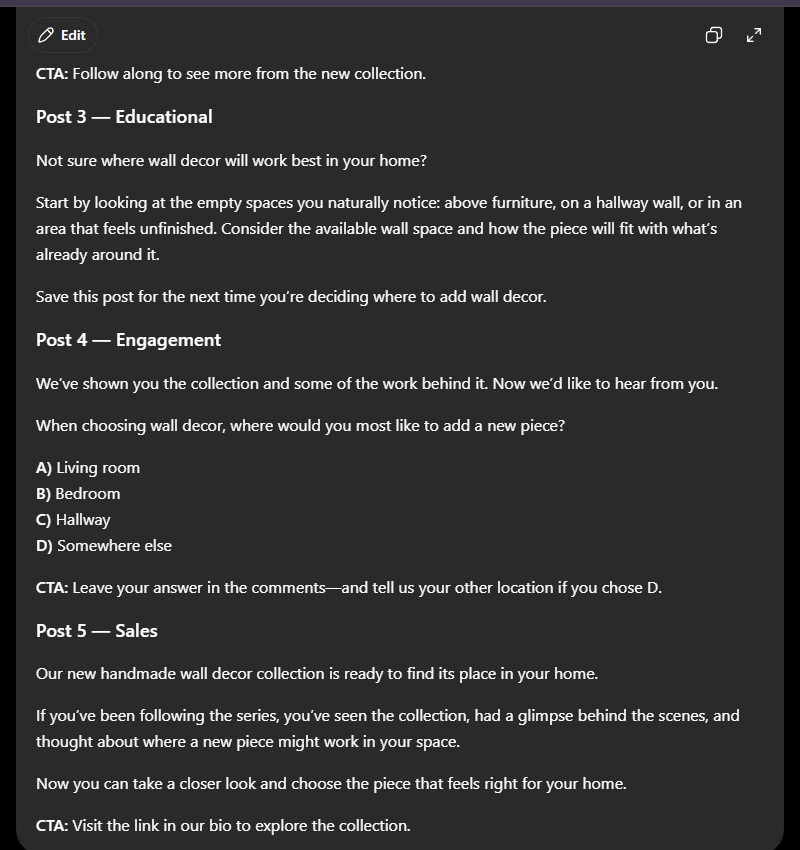
ChatGPT completed the campaign with educational, engagement, and sales posts.
The structure was practical and easy for a solo business owner to implement.
Claude’s campaign
Claude followed the same five-part structure but gave the captions a noticeably more conversational voice.
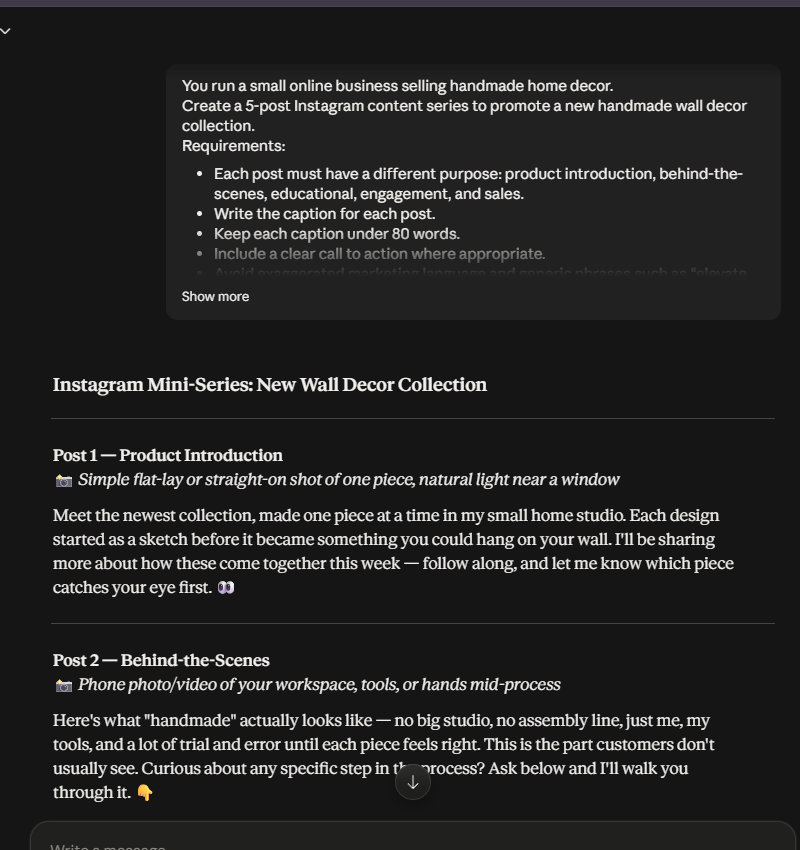
Claude’s opening posts for the same Instagram campaign.
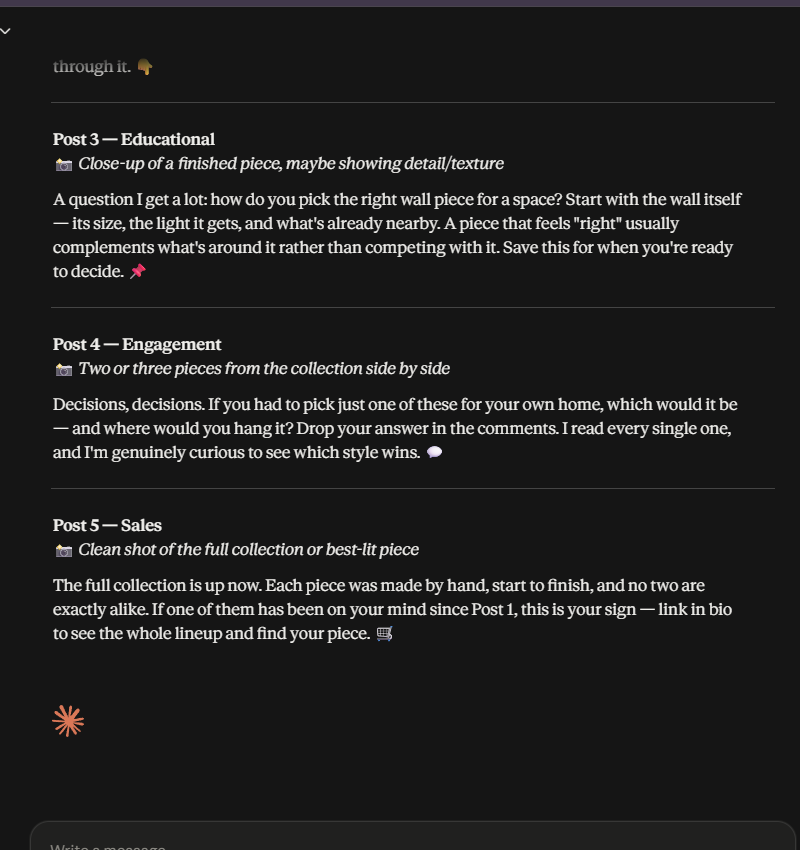
Claude’s educational, engagement, and sales captions.
Some of Claude’s wording was more engaging, but it again showed a tendency to embellish. Statements suggesting that every piece was made entirely by hand or that no two pieces were exactly alike went beyond the information supplied in the prompt.
Winner: ChatGPT
For pure creative tone, I preferred parts of Claude’s output.
But this test deliberately included strict factual constraints.
ChatGPT respected those boundaries more consistently while still creating a usable campaign, so it gets the win.
ChatGPT vs Claude: Test Results
| Test | Winner |
|---|---|
| Customer apology email | ChatGPT |
| Business description rewrite | ChatGPT |
| Growth strategy | ChatGPT |
| Business performance analysis | Claude |
| Instagram content campaign | ChatGPT |
The score alone, however, doesn’t tell the whole story.
Claude’s strongest outputs were often the ones where interpretation and natural language mattered most. ChatGPT’s advantage appeared when the instructions contained explicit boundaries that needed to be followed carefully.
Where ChatGPT Performed Better
Across these tests, ChatGPT was more consistent about respecting the information supplied in the prompt.
That was particularly noticeable when I explicitly prohibited invented facts.
It also tended to organize business recommendations clearly, which made the responses easy to turn into action plans.
For small-business owners, I would choose ChatGPT when the task involves:
- Following detailed instructions
- Working within specific constraints
- Structured planning
- Customer communication where unsupported promises could be risky
- Producing content that must remain close to supplied facts
Where Claude Performed Better
Claude often produced writing that felt more natural and conversational.
Its strongest performance came in the business-analysis test, where it connected multiple pieces of information effectively while still noting limitations in the available data.
I would particularly consider Claude for:
- Brainstorming
- First drafts where personality matters
- Exploring different ways to communicate an idea
- Analyzing information when you want a detailed narrative explanation
However, I would review factual statements carefully when the prompt contains strict boundaries.
ChatGPT vs Claude for Small Business: Which Should You Choose?
After testing both with the same five tasks, ChatGPT would be my first choice for most small-business owners.
The reason isn’t that Claude produced poor answers. It didn’t.
In several cases, Claude’s writing was actually more engaging.
The deciding factor was reliability under constraints.
A business owner asking AI to write customer emails, analyze numbers, prepare marketing content, or help make decisions needs more than good prose. The assistant also needs to distinguish between information it was given and information it is merely assuming.
ChatGPT did that more consistently in these tests.
Claude remains an excellent alternative, particularly when writing quality and conversational tone are priorities.
And there is no reason a business owner has to use only one.
One practical approach is to use ChatGPT for structured work and fact-sensitive tasks, while using Claude as a second perspective for brainstorming, writing alternatives, or deeper narrative analysis.
Final Verdict
Best overall for small business: ChatGPT
Best for natural, conversational writing: Claude
Best for structured instruction-following: ChatGPT
Best performance in my business-analysis test: Claude
Ultimately, the better AI depends on the work you want it to do.
But based on these five hands-on tests, I would start with ChatGPT and use Claude when I wanted a second perspective or a more conversational alternative.
Frequently Asked Questions
Were ChatGPT and Claude tested on the same tasks?
The comparison uses the same practical business scenarios so the outputs can be judged against the same requirements and constraints.
Does one tool always outperform the other?
No. Performance depends on the task, prompt, model version, and the standard you use for quality. Treat the results as a starting point for your own workflow.
What should businesses compare besides answer quality?
Compare accuracy, consistency, speed, formatting, privacy, integrations, and total cost—not just which answer sounds more polished.
Should AI output be sent to customers without review?
No. Review facts, tone, commitments, pricing, and any sensitive details before sharing an AI-assisted response externally.
Leave a Reply