

A hands-on comparison of ChatGPT, Claude, and Gemini for practical administrative work
The best AI tools for medical practices can support the administrative side of a clinic. They can help draft patient messages, organize policies, and turn routine instructions into workable processes.
But usefulness depends on more than polished wording: an assistant must follow constraints, avoid inventing clinic details, and make uncertainty visible.
In this comparison, I gave ChatGPT, Claude, and Gemini the same three fictional medical-practice tasks. The tests focused on appointment communication, policy explanation, and missed-appointment administration. None of the tasks involved diagnosis, treatment, or medical advice.
The results were not a sweep for one tool. All three handled the first task successfully, ChatGPT and Gemini were strongest on the second, and Claude had a narrow advantage on the third. The best choice therefore depends on the workflow being evaluated. These results show that the best AI tools for medical practices should be judged by the workflow, not by a universal ranking.
Quick Verdict: Best AI Tools for Medical Practices
⚙️ Best for: ChatGPT, Claude, and Gemini were all useful for different medical-practice administrative workflows, from appointment communication to policy explanation and missed-appointment planning.
🧩 Main limitation: These were fictional administrative tasks, not clinical tests. The outputs still require human review, and any scheduling capability, contact method, or policy detail must be verified before use.
🏆 Overall verdict: There was no universal winner. ChatGPT and Gemini were strongest for the tightly constrained policy FAQ, while Claude had a narrow advantage in the missed-appointment workflow.
| Test | Best result | What the test showed |
| Test 1 | Tie | All three produced usable appointment confirmations while respecting the fictional details. |
| Test 2 | ChatGPT and Gemini | Both followed the exact five-question requirement; Claude added a sixth question. |
| Test 3 | Claude, narrowly | Claude built the most disciplined workflow and clearly flagged a capability that needed confirmation. |
No tool was declared a universal winner. The useful question is which assistant handled a particular administrative workflow with the least unsupported assumption and the least human correction.
How I Tested the Best AI Tools for Medical Practices
Each assistant received the same prompt in its public interface. The scenarios used fictional names, dates, addresses, policies, and appointment data. I evaluated the outputs for five things: adherence to the requested format, factual discipline, clarity, usefulness for the stated task, and whether missing information or unsupported assumptions were identified.
The screenshots below are cropped records of the actual outputs. They are included as evidence of what each tool produced, not as proof that any tool should be used without human review. For reference, I also maintain comparisons of ChatGPT and Gemini for small business and ChatGPT and Claude for small business.
Test 1: Writing an Appointment Confirmation Message
The first task tested whether each assistant could turn a small set of appointment facts into a patient-facing confirmation without adding medical or clinic information.
The prompt supplied a fictional patient name, appointment date and time, street address, photo-ID instruction, and 15-minute arrival instruction. Each tool had to write an email or SMS under 100 words and avoid medical advice, diagnosis, treatment information, and invented clinic details.
ChatGPT
ChatGPT produced a concise confirmation that preserved the patient name, appointment date, time, location, photo-ID reminder, and early-arrival instruction. It did not add a practice name, contact information, or medical content.
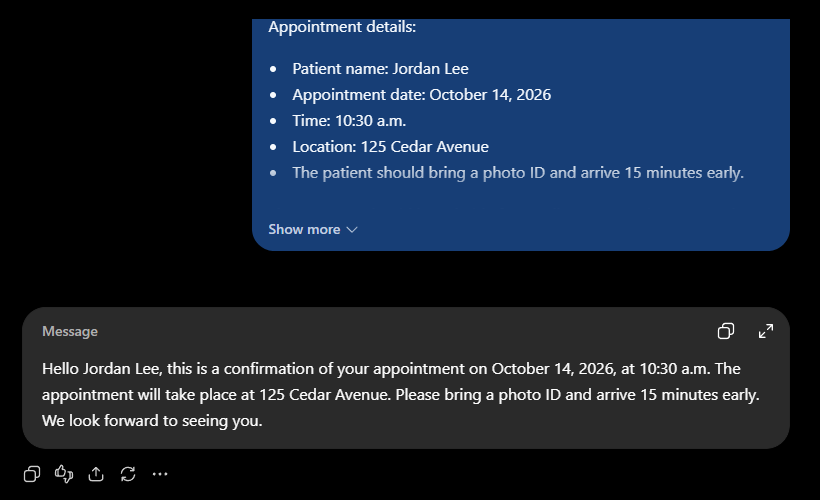
ChatGPT produces a concise appointment confirmation from the supplied fictional details.
Claude
Claude also returned a clear patient-facing message using the provided facts. The wording was suitable for an email or text message and did not introduce unsupported practice details.
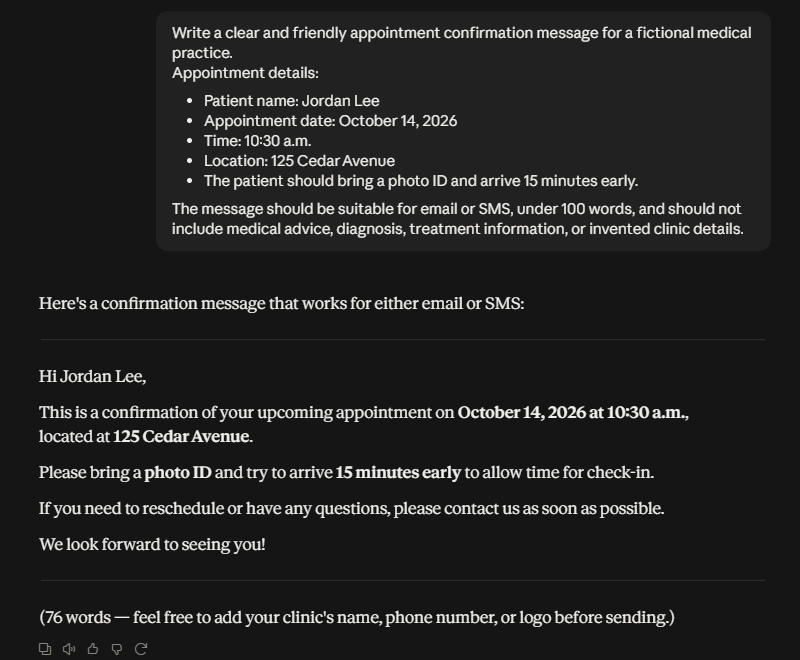
Claude keeps the appointment confirmation focused on the supplied date, time, location, and instructions.
Gemini
Gemini met the same core requirements. Its answer confirmed the appointment and included the arrival and identification reminders without moving into medical advice or invented clinic information.
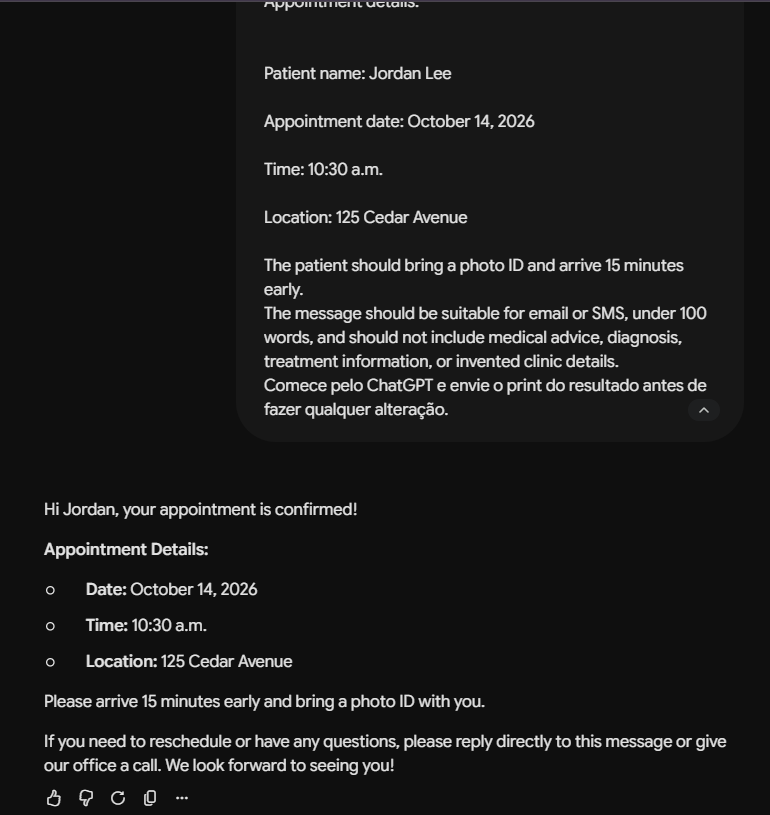
Gemini produces another usable confirmation message without adding clinical information.
Test 1 Verdict
This was a tie. All three assistants completed the task successfully, so the result did not justify naming one tool superior. In a real practice, the final message would still need review for the practice’s actual contact, cancellation, privacy, and scheduling procedures.
Test 2: Creating a Patient-Facing Appointment Policy FAQ
The second task was stricter. Each assistant had to use only a fictional policy, produce exactly five questions and answers, stay under 200 words, and clearly say when the policy did not provide a specific detail. For the best AI tools for medical practices, precise instruction-following matters as much as fluent writing.
The policy covered cancellation and rescheduling by phone or email, 24 hours’ notice when possible, possible fees without a stated amount, forms for new patients, no walk-ins, and office hours from Monday through Friday, 8 a.m. to 5 p.m. The prompt prohibited invented contact details, insurance information, payment details, fee amounts, medical advice, diagnosis, and treatment information.
ChatGPT
ChatGPT followed the exact five-question requirement and stayed within the requested scope. It explained that the policy did not provide specific contact details or a fee amount instead of filling those gaps with assumptions.
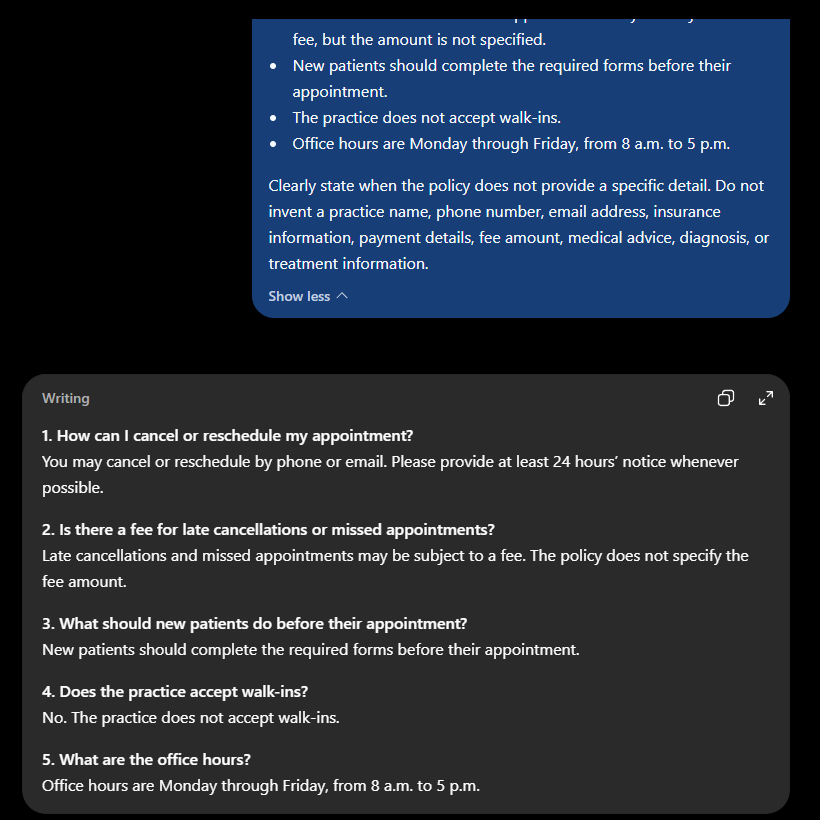
ChatGPT organizes the policy into exactly five patient-facing questions and answers.
Claude
Claude’s response was generally clear, but it missed the most explicit formatting constraint. After five numbered questions, it added “What are your office hours?” as an additional question, resulting in six questions rather than exactly five. It also stated that appointments must be scheduled in advance, which is a reasonable interpretation of the no-walk-ins rule but is not stated in those words by the policy.
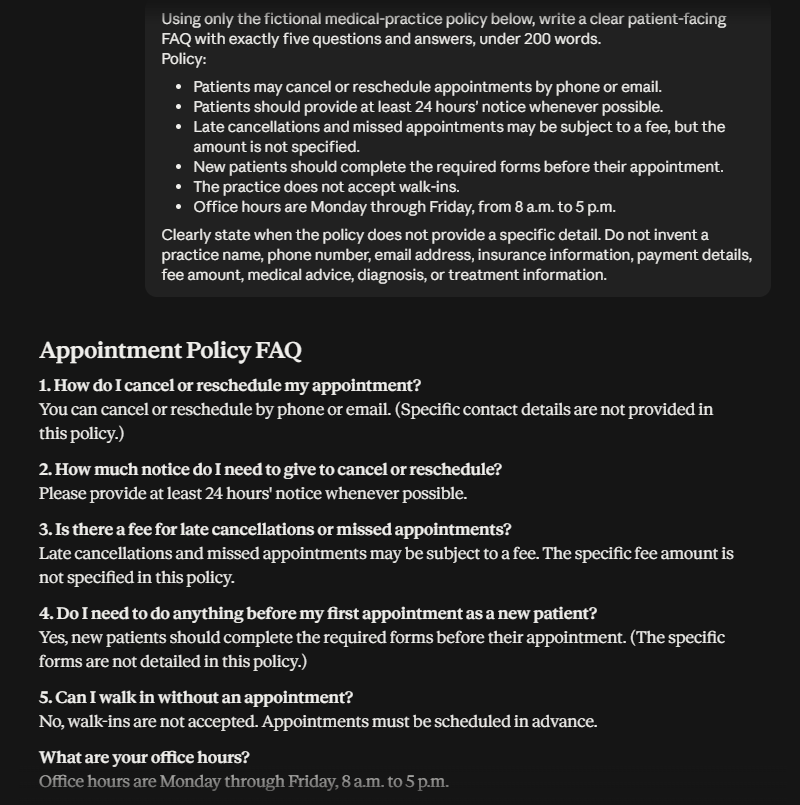
Claude provides useful policy answers but adds a sixth question after the required five.
Gemini
Gemini met the exact five-question requirement and covered the relevant policy points without inventing a practice name, contact details, fees, or clinical information. Its answer also kept the distinction between stated policy and missing information.
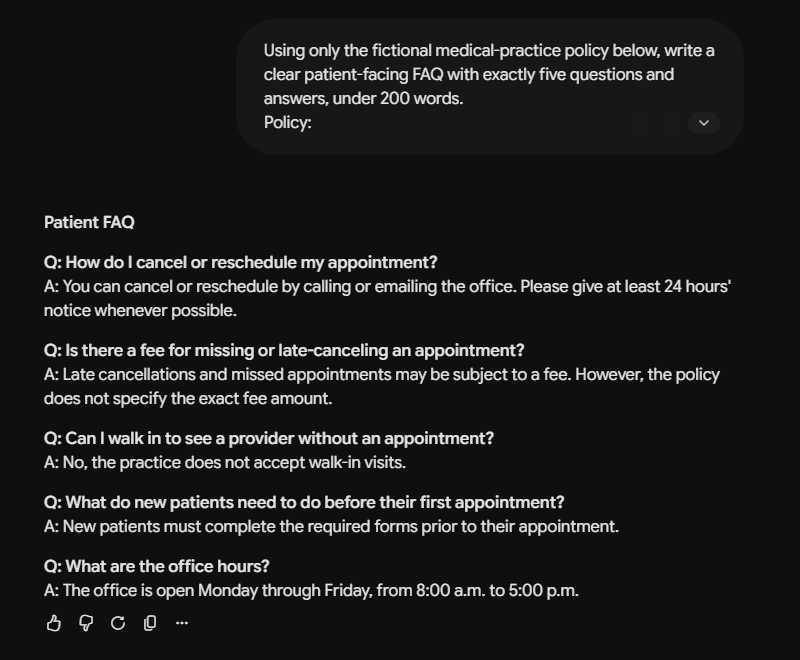
Gemini follows the exact five-question limit while summarizing the fictional policy.
Test 2 Verdict
ChatGPT and Gemini tied for the strongest result. Claude’s content was mostly useful, but failing an explicit “exactly five” instruction matters in a task where format control is part of the job.
Test 3: Designing a Workflow to Reduce Missed Appointments
The third task asked each assistant to create an administrative workflow using only a small set of operational facts. The response had to contain six to eight numbered steps, one reminder SMS under 40 words, and three measurable indicators, while avoiding any guarantee of improvement.
The fictional practice schedules 20 appointments per weekday, has a recent 15% no-show rate, uses one receptionist, has patient phone numbers, can send an SMS 48 hours before an appointment and another 24 hours before if the patient has not confirmed, and accepts confirmation or rescheduling replies by SMS.
ChatGPT
ChatGPT produced a seven-step workflow, a sample reminder, and three measurable indicators. It also identified details that would require confirmation, including SMS authorization and how scheduling changes should be recorded. That caution made the added assumptions visible, although it kept ChatGPT just behind Claude on this task.
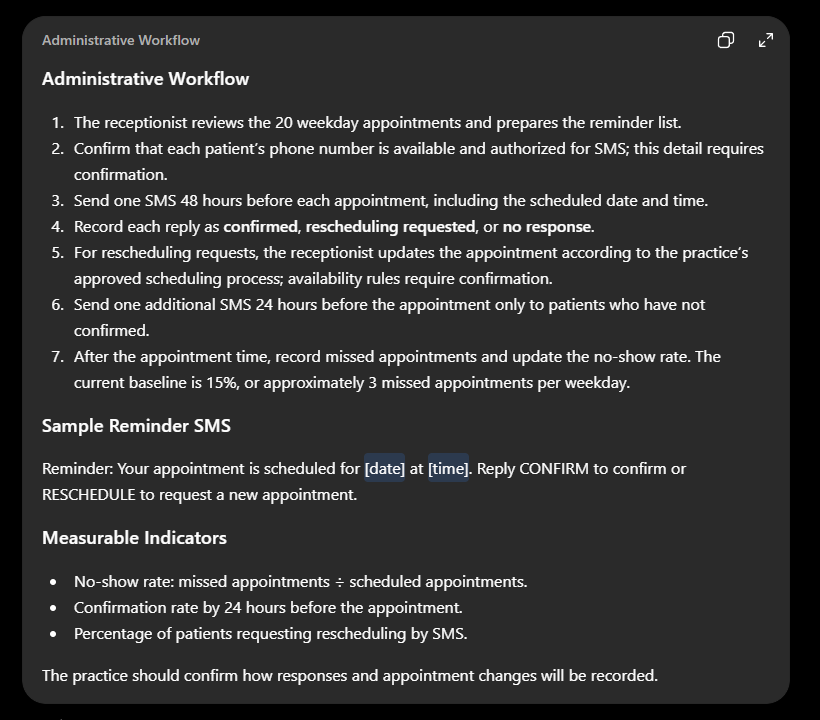
ChatGPT creates a complete reminder workflow and identifies operational details that need confirmation.
Claude
Claude produced an eight-step workflow, a 29-word reminder SMS, and three measurable indicators. Its strongest feature was explicit uncertainty management: it identified phone follow-up as something that required confirmation because it was not among the stated capabilities. The workflow was therefore practical while remaining clear about its limits.
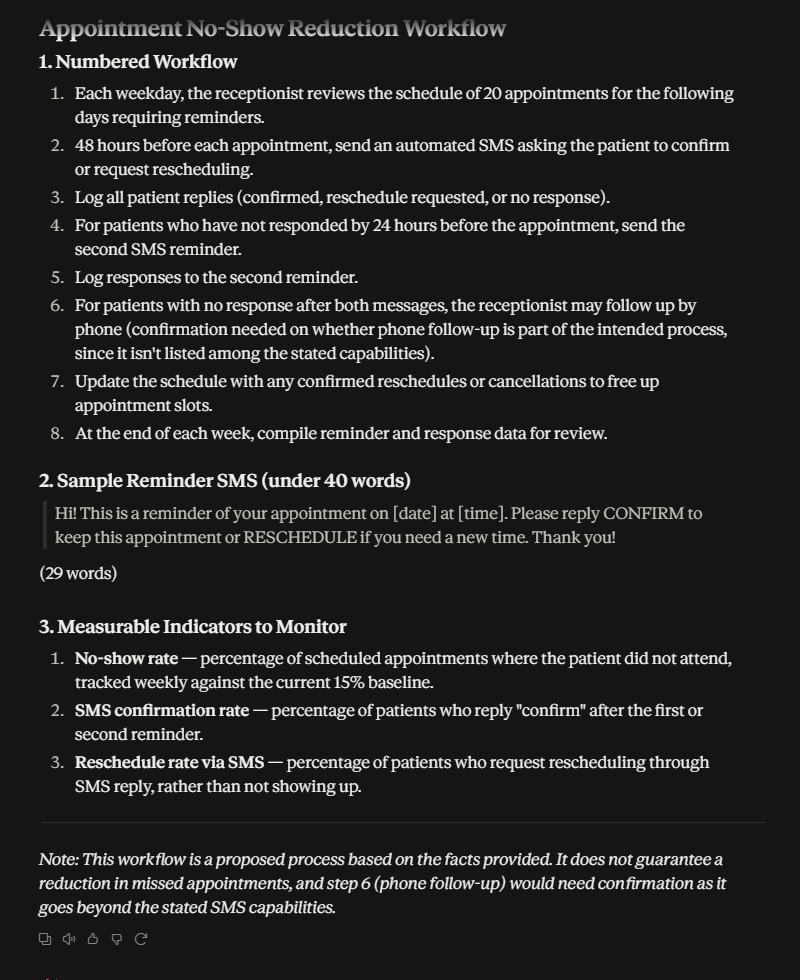
Claude provides an eight-step workflow, a short reminder SMS, indicators, and a clear confirmation note.
Gemini
Gemini produced the requested sections, but it introduced more unsupported operational assumptions. It referred to automatic system sending, phone contact, and offering empty slots to a waitlist. Some of these additions were marked as requiring confirmation, but not all were clearly qualified, which reduced the answer’s factual discipline.
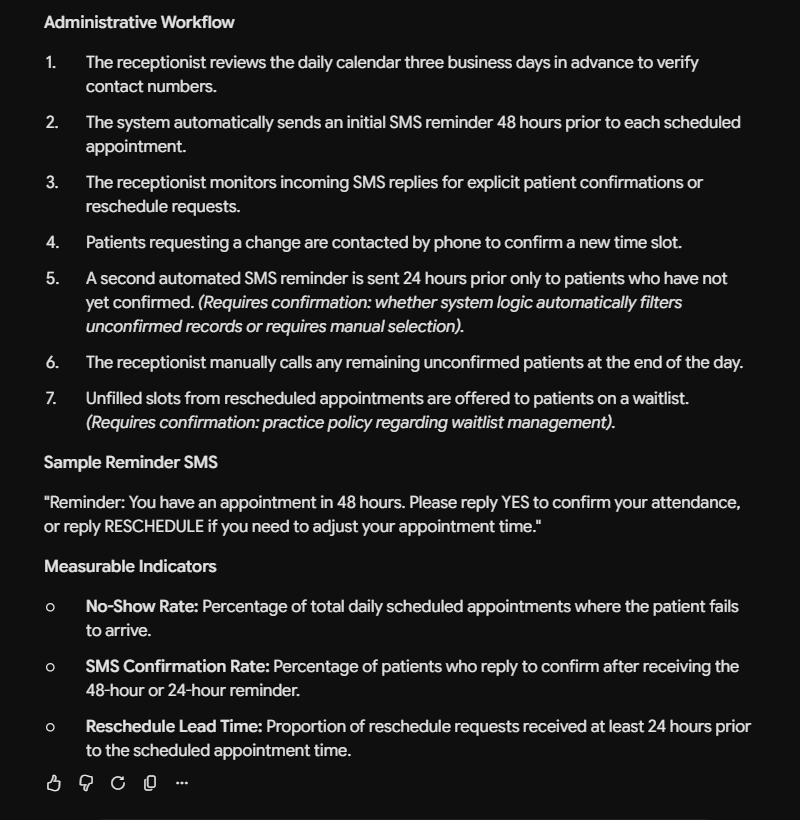
Gemini supplies the requested workflow but adds several operational assumptions that need review.
Test 3 Verdict
Claude won by a small margin. ChatGPT was close and showed good caution, while Gemini was more willing to fill in missing operational details. None of the outputs proves that the proposed workflow would reduce no-shows; the practice would need to implement, monitor, and evaluate any process before drawing that conclusion.
Final Comparison
The three tests produced a more useful result than a simple win-loss sweep. For a basic appointment confirmation, all three assistants were adequate. For a tightly constrained policy FAQ, ChatGPT and Gemini followed the exact format better than Claude. For a multi-step administrative workflow, Claude showed the strongest balance between usefulness and explicit limits. That is why the best AI tools for medical practices may differ from one administrative task to another.
Choose any of the three for a straightforward appointment confirmation, provided the final message is checked against the practice’s real procedures.
Prefer ChatGPT or Gemini when an FAQ must obey an exact question count and stay close to a supplied policy.
Consider Claude for a structured administrative workflow when clearly labeling unknown capabilities is especially important.
Keep a human reviewer responsible for privacy, scheduling rules, contact details, and any decision that affects patients.
The overall lesson is that the best AI tools for medical practices are not necessarily the ones that sound most confident. In administrative work, the stronger result often comes from the assistant that follows the brief, avoids unsupported details, and makes the remaining human decisions easy to see.
Important Note
This comparison evaluates administrative writing and workflow organization only. It is not medical advice, and the fictional outputs should not be used as patient-care instructions without review and adaptation to the practice’s actual legal, privacy, and operational requirements.
Frequently Asked Questions
Can AI tools replace clinical judgment?
No. They may support administrative and communication workflows, but clinical decisions, patient safety, and professional responsibility remain with qualified staff.
What kinds of tasks were tested?
The article examines practical medical-practice workflows such as patient communication and administrative handling, with attention to accuracy and review.
How should a practice handle patient information?
Use tools and accounts approved for the practice, share only the minimum necessary information, and follow applicable privacy and security requirements.
Should an AI-generated message be sent without review?
No. Check names, dates, instructions, medical wording, and any detail that could confuse or harm a patient before sending.
Leave a Reply