
Choosing between ChatGPT and Gemini for a small business can be difficult when both tools appear capable of handling everything from research to marketing.
In this ChatGPT vs Gemini for small business comparison, I tested both tools using the same five real-world tasks.
Rather than relying on feature lists, I compared their responses directly under the same conditions.
I used the same prompts, the same fictional business scenario, and fresh conversations for each test. The tasks covered research with sources, business data analysis, prioritization, marketing campaign planning, and customer service.
The final score was surprisingly one-sided:
ChatGPT won all five tests.
But the 5–0 score doesn’t tell the whole story. Gemini performed well in several tests, and two of ChatGPT’s wins were by a small margin.
The biggest difference wasn’t simply writing quality. It was how carefully each model handled missing information, constraints, and assumptions.
Quick Verdict: ChatGPT vs Gemini for Small Business
Overall winner: ChatGPT
Final score: ChatGPT 5 — Gemini 0
Based on these five tests, I would choose ChatGPT for small-business tasks where careful reasoning, following detailed instructions, and avoiding unsupported assumptions are important.
Gemini was often well organized and easy to scan. It also produced some strong practical ideas.
However, in several tests, Gemini introduced plausible details or conclusions that weren’t fully supported by the information I provided. ChatGPT was generally more cautious about separating what was known from what still needed to be verified.
That matters in business tasks, where a reasonable-sounding assumption can change the recommendation.
This doesn’t mean ChatGPT is better than Gemini at every possible task. It means ChatGPT performed better across the five small-business scenarios I tested here.
How I Tested ChatGPT and Gemini
I wanted this ChatGPT vs Gemini comparison to reflect tasks a small online business owner might actually give an AI assistant rather than isolated benchmark questions.
The fictional business used throughout the tests was a small online store selling handmade home decor.
For every test, I:
- used the same prompt with ChatGPT and Gemini;
- started a fresh conversation;
- provided the same business information and constraints;
- evaluated the initial response without asking either model to correct it;
- compared usefulness, reasoning, instruction-following, and unsupported assumptions.
Here was the final score:
| Test | Winner |
|---|---|
| Research with sources | ChatGPT |
| Business data reasoning | ChatGPT |
| Turning messy notes into an action plan | ChatGPT — by a small margin |
| Creating a 7-day marketing campaign | ChatGPT — by a small margin |
| Handling a difficult customer complaint | ChatGPT |
Here’s what happened in each test.
Test 1: Research With Sources
Winner: ChatGPT
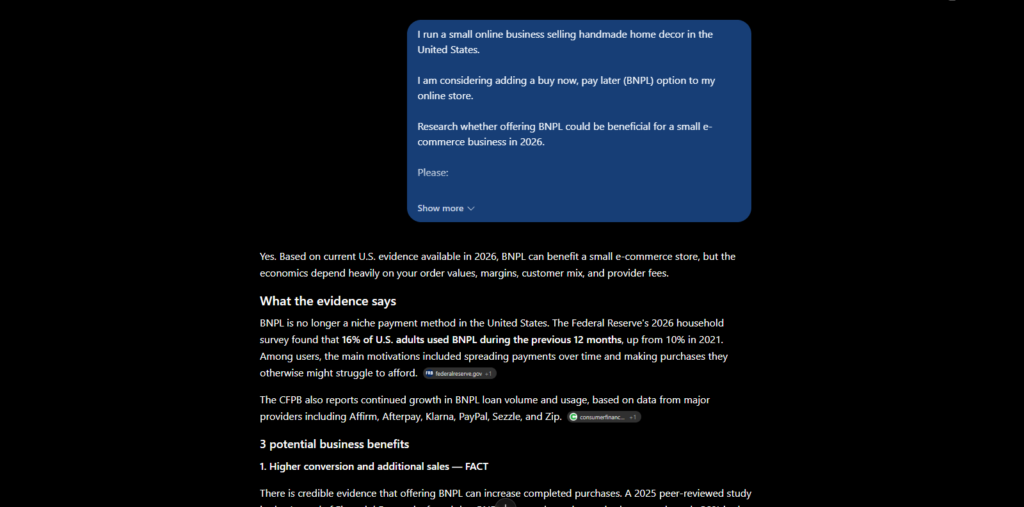
For the first test, I asked both tools to research whether a small U.S. e-commerce business selling handmade home decor should consider offering buy now, pay later (BNPL).
The prompt required three potential benefits, three risks, current and verifiable information, sources for important factual claims, and a recommendation.
I also explicitly told both models not to guess when reliable evidence wasn’t available.
How ChatGPT performed
ChatGPT produced a detailed research-based answer and made a noticeable effort to distinguish facts from business interpretation.
It referenced sources including government and institutional sources alongside academic and commercial information.
More importantly, when discussing evidence that wasn’t specific to a handmade home decor store, ChatGPT acknowledged that limitation instead of presenting the findings as guaranteed results for the hypothetical business.
Its final recommendation was to test BNPL cautiously and measure the results rather than assume that offering it would automatically improve the business.
How Gemini performed
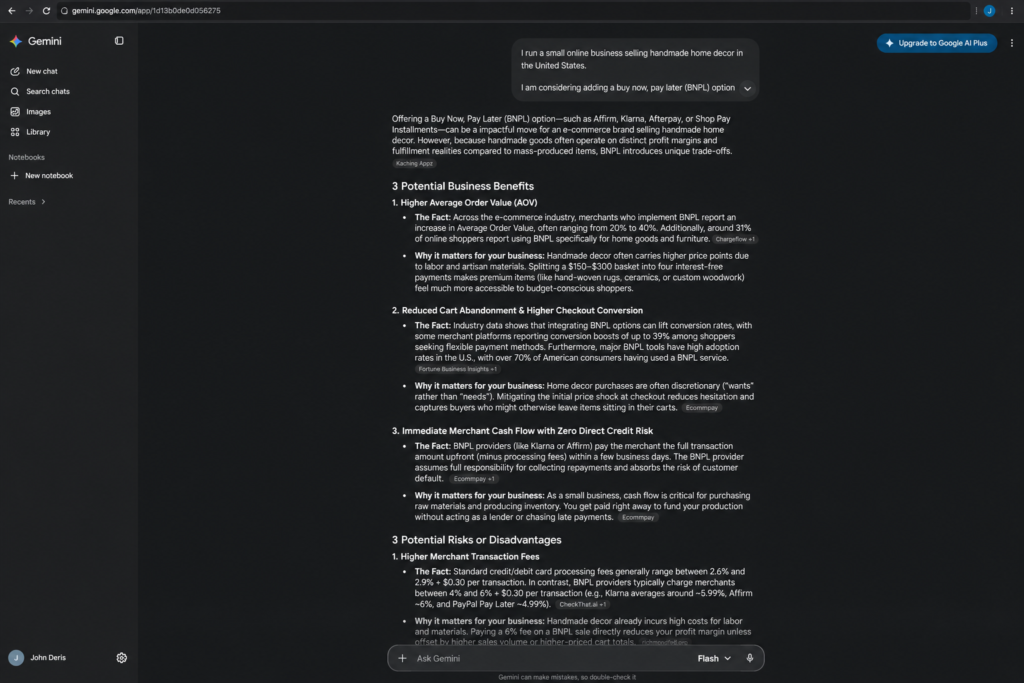
Gemini’s response was particularly easy to scan.
Its “The Fact” and “Why it matters for your business” structure made the research accessible, and it included a useful comparison table.
However, Gemini also made several specific claims and recommendations based on weaker commercial evidence or assumptions that weren’t provided in the prompt.
It introduced details about the hypothetical handmade business and suggested specific order-value thresholds despite not having actual order-value data for the store.
Why ChatGPT won Test 1
Both responses were useful, but ChatGPT was more disciplined about evidence.
It relied more heavily on authoritative sources and did a better job distinguishing verified information from business-specific assumptions.
For a research task where the prompt explicitly required verifiable evidence and warned against guessing, that gave ChatGPT the advantage.
Score: ChatGPT 1 — Gemini 0
Test 2: Business Data Reasoning
Winner: ChatGPT
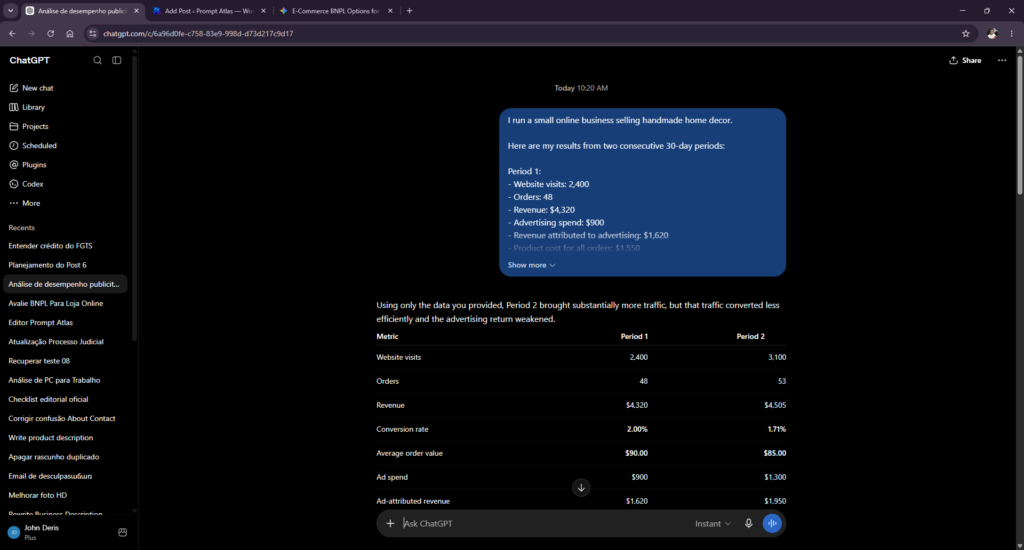
For the second test, I gave both models data from two consecutive 30-day periods.
The numbers included website visits, orders, revenue, advertising spend, advertising-attributed revenue, and product costs.
Both tools had to calculate conversion rate, average order value, ROAS, and percentage changes before deciding whether an additional $400 in advertising spend appeared justified.
This test contained an important trap: the available numbers could show changes in performance, but they weren’t enough to prove that the additional advertising caused a particular profit outcome.
Both models got the core calculations right
They calculated:
- Conversion rate: 2.00% → 1.71%
- Average order value: $90 → $85
- ROAS: 1.80x → 1.50x
- Website traffic: +29.17%
- Orders: +10.42%
- Revenue: +4.28%
- Advertising spend: +44.44%
So this wasn’t decided by basic arithmetic.
Where Gemini went too far
Gemini subtracted product costs and advertising spend from revenue for each period and used the resulting difference to support the conclusion that the additional $400 in advertising wasn’t justified.
The problem was attribution.
The supplied data didn’t establish that the extra advertising caused the overall change, and it didn’t provide the product costs specifically associated with incremental ad-driven sales.
Gemini later acknowledged some missing information, but its main conclusion was stronger than the evidence allowed.

ChatGPT handled the limitation better
ChatGPT also recognized the negative signals.
Advertising spend increased substantially while ROAS declined, and the additional $400 in advertising generated only $330 more in advertising-attributed revenue.
But it stopped short of claiming that the extra advertising had caused a specific loss.
Instead, it explained what additional information would be needed to reach a firmer conclusion.
Why ChatGPT won Test 2
Both models calculated the requested metrics correctly.
ChatGPT won because it was more careful about what those calculations could actually prove.
That distinction between identifying a worrying trend and claiming causation was the deciding factor.
Score: ChatGPT 2 — Gemini 0
Test 3: Turning Messy Business Notes Into an Action Plan
Winner: ChatGPT — by a small margin
The third test was deliberately less mathematical.
I gave both tools a collection of unorganized notes from a solo business owner.
The notes included unanswered Instagram messages, unfinished product photos, an inactive email list, questions about product dimensions, increasing website traffic, possible gift wrapping, a marketing budget, and other tasks.
The models had eight hours to select and prioritize five business-improvement actions.
ChatGPT’s approach
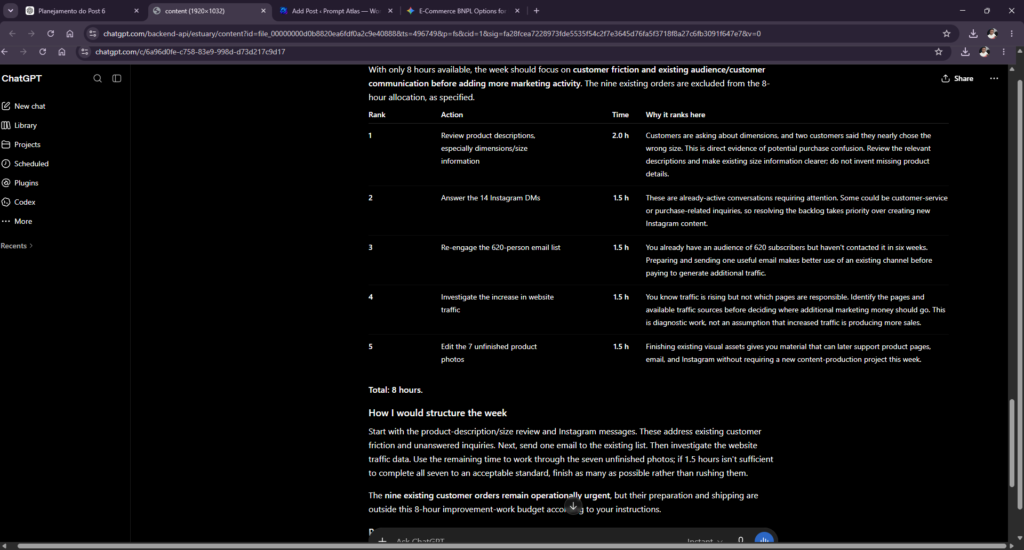
ChatGPT prioritized:
- Reviewing product descriptions and size information
- Responding to unanswered Instagram messages
- Re-engaging the email list
- Investigating where increasing website traffic was coming from
- Editing unfinished product photos
It allocated exactly eight hours across those tasks.
It also correctly kept existing order fulfillment outside the eight-hour improvement budget because the prompt explicitly excluded that work.
ChatGPT didn’t treat three gift-wrapping questions as proof of broader demand, and it recommended gathering more information before spending the available $300 on advertising.
Gemini’s approach
Gemini also created a practical and well-organized plan.
One of its interesting choices was prioritizing analytics while postponing the unfinished photos, which was a perfectly defensible approach.
However, it listed preparing and shipping existing orders as its number-one priority while assigning that task zero hours because the prompt excluded fulfillment from the available eight hours.
That made its five-priority structure slightly inconsistent.
It also suggested that responding to the Instagram DMs could immediately convert traffic into orders, even though the prompt didn’t tell us what those messages contained.

Why ChatGPT won Test 3
This was close.
Gemini’s plan was useful, and I could see a small-business owner following much of it.
But ChatGPT followed the time constraint more precisely and made fewer assumptions about the available information.
Score: ChatGPT 3 — Gemini 0
Test 4: Creating a 7-Day Marketing Campaign
Winner: ChatGPT — by a small margin
For Test 4, I wanted to move away from research and analysis.
Both models had to create a seven-day campaign for a new collection of personalized handmade wall decorations.
The resources were deliberately limited:
- an email list
- an online store
- a smartphone
- five total hours for campaign creation
- no paid advertising budget
They also weren’t allowed to invent materials, dimensions, prices, discounts, production times, reviews, shipping promises, or other unspecified product details.
Gemini was strong creatively
Gemini created the campaign concept “Made with Your Details.”
It also provided a clear production-time breakdown and built a coherent sequence across Instagram and email.
In some respects, I preferred Gemini’s central campaign concept.
But it started adding details that weren’t in the prompt.
For example, it described a particular process for customers to select a design and enter personalization information during checkout.
The original information only said that products were personalized using customer-provided information. It didn’t explain how that information was collected.

ChatGPT stayed closer to the brief
ChatGPT used the concept “Made Personal, Made by Hand.”
Its concept may have been slightly less distinctive, but the execution was very practical.
It deliberately reused photos and videos and even included a day without a new post rather than forcing seven separate pieces of content.
That made the plan realistic for a solo owner with only five hours available.
It also stayed closer to the verified product information when writing customer-facing copy.
Why ChatGPT won Test 4
Gemini deserves credit here. Its campaign was organized and had a strong central idea.
But the prompt specifically tested whether the models could create useful marketing without filling information gaps with invented product or purchasing details.
ChatGPT handled that constraint better.
This was another narrow win.
Score: ChatGPT 4 — Gemini 0
Test 5: Handling a Difficult Customer Complaint
Winner: ChatGPT
The final test involved a customer complaint.
A customer had ordered a personalized handmade wall decoration as a gift. It arrived on time, but the customer said the personalization was wrong and claimed they had entered the correct information when ordering.
The critical detail was that the business owner hadn’t checked the original order yet.
Neither model was allowed to assume who was responsible or invent refund, replacement, return, shipping, or personalization policies.
Both models started correctly
Both ChatGPT and Gemini recognized that the first step should be checking the original order information.
They also recommended getting a photo of the received product and comparing the available evidence before deciding what happened.
Both drafted professional customer emails without immediately blaming either party.
Gemini introduced possible remedies
Gemini’s response was clearly structured and practical.
However, when discussing possible outcomes, it introduced options such as remaking the product, issuing a full refund, offering a discount, or applying return terms.
It presented these as conditional possibilities rather than immediate promises, but those remedies still hadn’t been provided as actual store policies.

ChatGPT was more disciplined
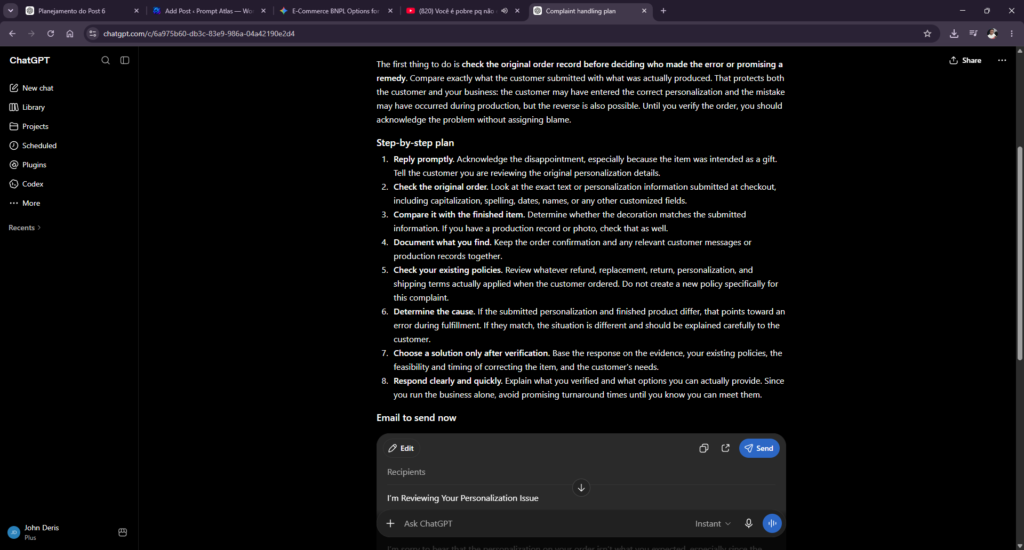
ChatGPT explicitly recognized that no refund, replacement, return, or personalization policy had been provided.
It recommended verifying the order, determining where the discrepancy occurred, checking the store’s actual policies, and only then deciding what solution could be offered.
Its customer email acknowledged the problem without admitting responsibility before the facts had been established.
Both responses could help a small-business owner handle the initial complaint.
But ChatGPT was more disciplined about missing information and avoided introducing remedies that hadn’t been authorized.
That was exactly what this test was designed to measure.
Final score: ChatGPT 5 — Gemini 0
ChatGPT vs Gemini: What I Learned From the 5 Tests
The final score looks much more dramatic than some of the individual comparisons felt.
Gemini wasn’t consistently producing bad answers. In fact, several were useful, well structured, and easy to read.
The pattern I noticed was more specific.
ChatGPT was better at handling constraints
Across the tests, ChatGPT was generally more careful when the prompt deliberately withheld information.
When there wasn’t enough evidence to establish something, it was more likely to acknowledge the limitation rather than quietly fill the gap.
That showed up in the BNPL research, advertising analysis, campaign planning, and customer complaint.
Gemini was often easier to scan
Gemini frequently organized information extremely well.
Tables, clear sections, short explanations, and practical formatting made several of its responses immediately usable.
Its marketing campaign concept was also one of its strongest moments in the comparison.
Small assumptions made a big difference
This became the most important lesson from the entire test.
Most of Gemini’s questionable assumptions were plausible.
That’s precisely why they matter.
A business owner could easily read a plausible statement and treat it as something established by the available information.
The best AI response isn’t always the one that provides the most detail. Sometimes it’s the one that knows which details it doesn’t actually know.
Which Is Better for Small Business: ChatGPT or Gemini?
Based on these five tests, ChatGPT was the better performer for my small-business scenarios.
It won the research and data-analysis tests because it handled evidence and uncertainty more carefully.
It narrowly won the planning and marketing tests because it followed detailed constraints more consistently.
And it won the customer-service test by refusing to assume business policies that hadn’t been provided.
Gemini still showed strengths in organization, presentation, and practical idea generation.
So I wouldn’t interpret this test as evidence that Gemini is a poor business tool — or that ChatGPT will win every task.
The result is narrower than that:
When I gave both tools the same five small-business tasks, ChatGPT produced the response I preferred in all five.
Final Verdict: ChatGPT Wins 5–0
My final result for this ChatGPT vs Gemini for small business comparison is:
ChatGPT: 5 wins
Gemini: 0 wins
Two of those victories were by a small margin, so the score alone exaggerates the distance between the tools.
Still, a consistent pattern emerged.
ChatGPT was better at recognizing when the information provided wasn’t enough to support a conclusion. It also followed restrictions more carefully and introduced fewer unsupported business assumptions.
Gemini’s strengths were different. Its answers were often well organized, visually clear, and practical.
For the kinds of small-business tasks I tested here, though, I would choose ChatGPT.
Want to see how ChatGPT performed against another major AI assistant? Read my ChatGPT vs Claude for small business comparison, based on five real-world tests.
The reason isn’t that it always wrote more or generated more ideas.
It was that, across these tests, ChatGPT was more reliable about knowing where the provided information ended and an assumption would begin.
If you’re comparing more options, see my guide to the best AI tools for small business, where I test and evaluate tools for practical business tasks.
Frequently Asked Questions
Were ChatGPT and Gemini tested on the same business tasks?
Yes. Using the same scenarios makes it easier to see how each tool handles the same brief, constraints, and expected output.
Which tool had the stronger overall result in this comparison?
ChatGPT had the stronger overall result in this test set, while Gemini remained useful for structured brainstorming and alternative drafts. That result is not a guarantee for every workflow.
Should a business switch tools based only on this article?
No. Re-run the most important task with your own data, check privacy and pricing, and measure whether the tool actually saves time.
What is the most important lesson from the tests?
A reliable workflow depends on clear instructions and human checking. A fluent answer is not automatically a correct or business-ready answer.
Leave a Reply