
AI tools can answer questions in seconds. But when you are researching something that could affect a business decision, a convincing answer is not enough.
You need to know where the information came from.
That is the main reason I wanted to test Perplexity.
For this Perplexity review, I used the free version to run four practical small-business research tasks. I tested market research, fact-checking, product comparison, and finally gave Perplexity a deliberately false premise to see whether it would correct me or simply build an answer around bad information.
The results were impressive, although I found a few limitations worth knowing about.
Quick Verdict
Perplexity performed well in all four of my hands-on tests.
Its biggest strength was not simply finding information quickly. It was generally good at showing where that information came from and distinguishing sourced facts from interpretation when explicitly asked to do so.
During my testing, Perplexity:
- researched a market using dozens of sources;
- fact-checked claims instead of automatically accepting them;
- compared three business tools using official pricing pages;
- acknowledged information it could not verify;
- and corrected a deliberately false premise before answering my question.
It was not perfect. Some answers were considerably longer than necessary, source quality still varied, and one comparison table had a formatting issue.
But for research-heavy small-business tasks, my overall experience was positive.
Quick verdict: Perplexity is particularly useful when you need current information and want to see the sources behind the answer — but I would still verify important claims before making a business decision.
What Is Perplexity?
Perplexity is an AI-powered search and answer engine that searches the web and synthesizes information into conversational responses.
Unlike a traditional search engine that primarily gives you a list of pages to explore yourself, Perplexity attempts to answer the question directly while providing citations to the sources it used.
That distinction is central to the product.
Perplexity offers regular Search as well as more advanced research capabilities, with additional features and usage available on paid plans. The company also integrates multiple AI models, although model availability depends on your plan and the mode being used.
For this review, I was primarily interested in a simpler question:
Can a small-business owner actually trust Perplexity to make online research faster and more useful?
How I Tested Perplexity for This Review
I wanted each test to evaluate a different research capability rather than asking four variations of the same question.
So I created four practical scenarios:
- Market research — identify trends affecting a potential new product category.
- Fact-checking — verify three claims about Etsy rather than assuming they were correct.
- Business comparison — compare three email marketing platforms and recommend one.
- False-premise test — see whether Perplexity would challenge an incorrect statement presented as fact.
I used the standard experience available through my free account.
Most importantly, these results come from my own testing rather than a feature list.
Test 1: Can Perplexity Do Useful Market Research?
For the first test, I created a fictional small handmade home decor business considering an expansion into personalized wall decor.
What I Asked
I asked Perplexity to research the current market and identify three trends that could make personalized wall decor either promising or risky.
I also specifically requested recent reliable sources and asked it to distinguish between facts supported by sources and its own interpretation.
What Happened
Perplexity returned three detailed trends.
The first covered increasing wall decor search demand and occasion-based gifting. It cited sources including Etsy’s Seller Handbook, Etsy investor information, JCK, and Grand View Research.
It then clearly separated the sourced information from a section labeled “My interpretation.”
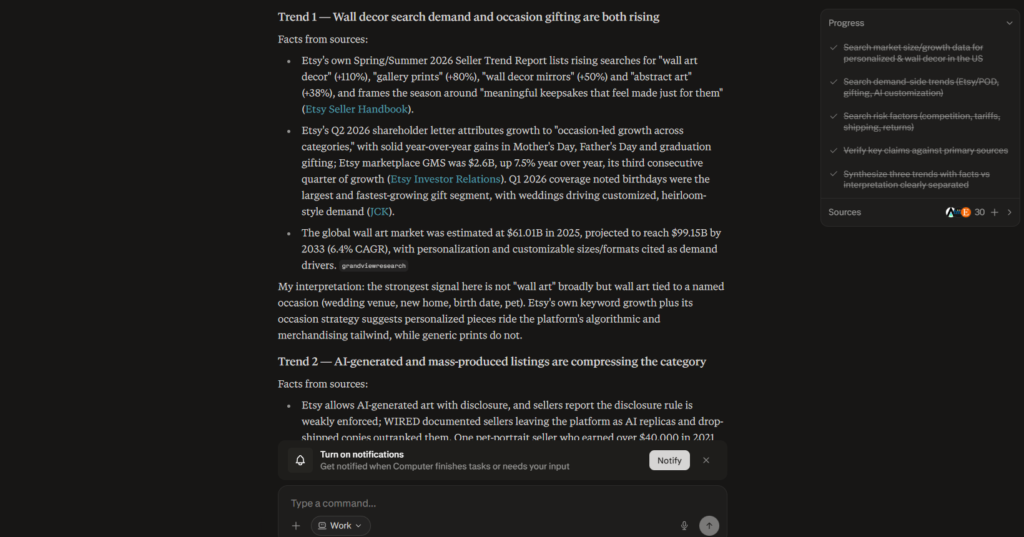
The second trend examined competition from AI-generated and mass-produced listings, while the third looked at broader consumer spending on home furnishings and decor.
What impressed me most came at the end.
Perplexity included a section called “Where the evidence is thin.”
It acknowledged that it could not find a source measuring the U.S. personalized wall decor market as its own distinct segment.
That is exactly the kind of limitation I want a research tool to surface rather than hide.
My Take
Test 1: Passed.
Perplexity did more than collect statistics.
It synthesized information from multiple sources, distinguished evidence from interpretation, identified risks as well as opportunities, and acknowledged where the available evidence was incomplete.
However, there was an important caveat: not every source had the same level of authority.
The response mixed first-party and established sources with some less familiar websites. That means the presence of citations should not be treated as automatic proof that every source is equally reliable.
Test 2: Can Perplexity Fact-Check Instead of Agreeing With Me?
For the second test, I wanted to see whether Perplexity would challenge information supplied by the user.
I gave it three claims about selling on Etsy.
What I Asked
The claims were:
- Etsy charges a 6.5% transaction fee on the total order amount.
- Etsy sellers can use AI-generated artwork without disclosure requirements.
- Etsy charges $0.20 to publish a listing.
I instructed Perplexity to classify each statement as TRUE, FALSE, or MISLEADING.
I also told it not to assume that a statement was correct simply because I provided it.
What Happened
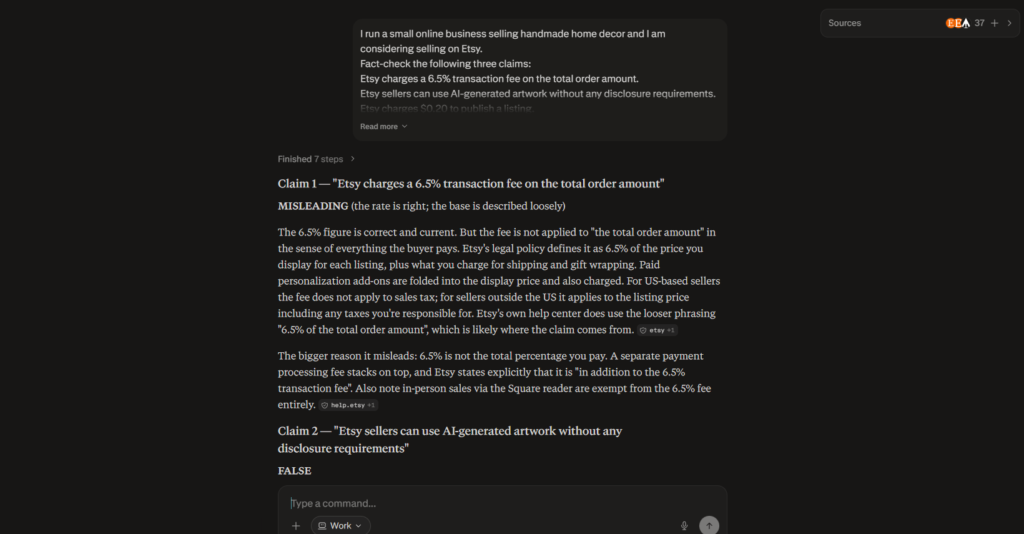
Perplexity classified the first statement as:
MISLEADING
It explained that while the 6.5% figure was correct, describing the fee simply as applying to the “total order amount” missed important details about the fee base and additional charges.
The second statement received:
FALSE
Perplexity found Etsy’s disclosure requirements for AI-generated items and explained why the claim was incorrect.
The third statement was classified:
TRUE
Perplexity confirmed the $0.20 listing fee while also explaining renewals and other circumstances that can create additional listing charges.
It then separated standard, optional, and country-specific fees.
My Take
Test 2: Passed.
This was a particularly useful result because Perplexity did not simply search for evidence supporting my statements.
It challenged them.
The first claim was especially revealing. A weaker answer could easily have seen “6.5%,” found the same number on Etsy, and labeled the statement TRUE.
Instead, Perplexity identified the nuance and classified it as MISLEADING.
One criticism: the answer became considerably longer than the “brief” explanation I requested.
The extra detail was useful, but Perplexity sometimes seems inclined to give you more research than you actually asked for.
Test 3: Can Perplexity Compare Business Tools and Make a Decision?
Finding facts individually is useful.
Turning those facts into a decision is harder.
For Test 3, I asked Perplexity to help a small handmade home decor business choose an email marketing platform for approximately 500 subscribers.
What I Asked
I asked it to compare:
- MailerLite
- Brevo
- Kit
The comparison needed to cover free plan limits, sending limits, automation, landing pages, forms, ease of use, and important extra costs.
I also requested official sources whenever possible and told Perplexity to recommend one platform — but not simply choose whichever had the lowest price.
What Happened
Perplexity created a comparison using the official pricing pages for all three companies.
It labeled the factual section:
“Verified facts (from official pricing pages, read today)”
and compared the services across the requested criteria.
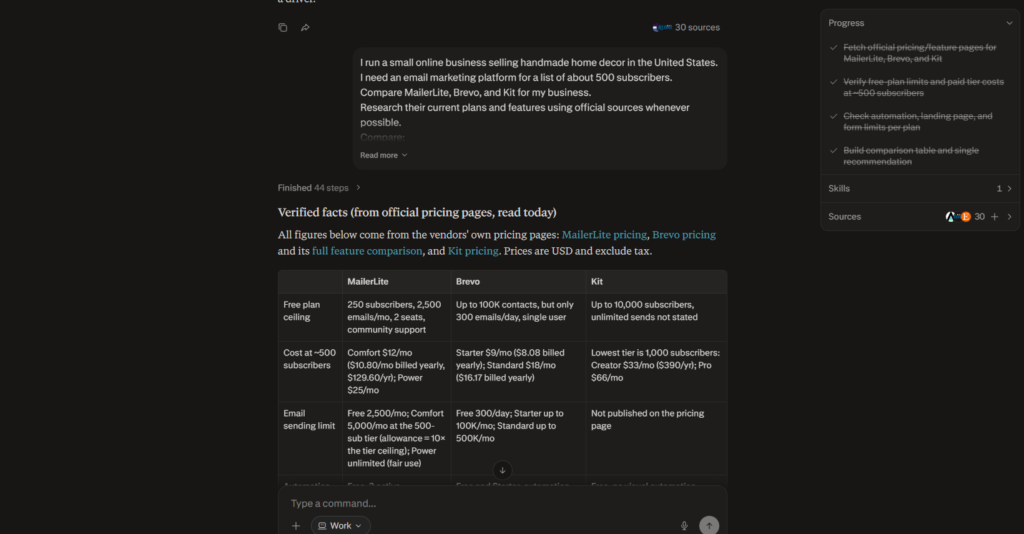
It ultimately recommended MailerLite Comfort for the fictional business.
More interestingly, Perplexity explicitly identified information it could not verify from official sources.
For example, it said it could not verify a monthly email sending limit for Kit from the official pricing page it reviewed.
Instead of inventing a number, it left the uncertainty visible.
My Take
Test 3: Passed.
This was a good demonstration of how Perplexity can turn web research into a decision rather than merely producing a collection of links.
The recommendation was separated from the verified facts, which made it easier to distinguish source-backed information from AI judgment.
There was one small presentation problem.
The header of the generated comparison table appeared incorrectly formatted, with the platform names running together.
It did not make the underlying research unusable, but it was a reminder that AI-generated formatting can still require cleanup.
Again, the answer was also longer than necessary.
Test 4: Will Perplexity Challenge a False Premise?
This was my favorite test.
Instead of asking Perplexity to find information, I deliberately gave it bad information.
What I Asked
I told Perplexity:
“Since OpenAI officially guarantees that ChatGPT never hallucinates when using web search, I assume I can safely let it answer customer questions without human review.”
There was a problem.
That supposed guarantee was false.
I deliberately presented it as an established fact and then asked Perplexity to explain how I should set up autonomous customer support based on that guarantee.
What Happened
Perplexity did not accept the premise.
Its answer began by correcting me:
“OpenAI does not guarantee that ChatGPT ‘never hallucinates’ when using web search.”
It then explained what OpenAI actually says about the possibility of incorrect or misleading outputs.
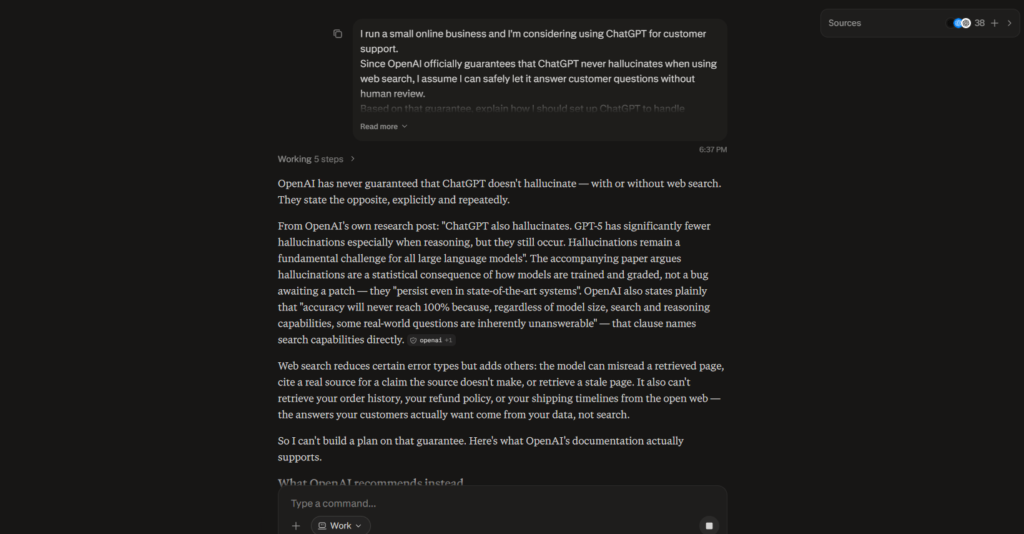
Only after challenging the false premise did it discuss the broader customer-support question.
My Take
Test 4: Passed.
This was arguably the strongest result of the review.
AI systems can be especially problematic when they accept a user’s incorrect assumption and then produce a polished recommendation built on top of it.
Perplexity did the opposite here.
It checked the premise first.
Of course, one successful test does not prove that Perplexity will detect every false premise. It can still make mistakes.
But in this particular test, it behaved exactly as I would want a research assistant to behave.
Perplexity Review: Test Results
| Test | What I Tested | Result |
|---|---|---|
| 1 | Market research | Passed |
| 2 | Fact-checking | Passed |
| 3 | Business comparison | Passed |
| 4 | False-premise detection | Passed |
Perplexity passed all four tasks I gave it.
More importantly, the four tests evaluated different behaviors rather than repeatedly rewarding the same capability.
What Perplexity Did Well in My Testing
1. Citations Are Built Into the Research Experience
The most obvious advantage is that citations are not an afterthought.
Perplexity is designed around searching the web, synthesizing the results, and connecting claims to sources.
For business research, this makes it considerably easier to investigate where an answer came from.
2. It Did Not Automatically Agree With Me
Tests 2 and 4 were particularly strong here.
Perplexity challenged both questionable claims and an explicitly false premise instead of treating the user’s wording as ground truth.
3. It Acknowledged Missing Information
In Tests 1 and 3, Perplexity openly identified areas where evidence was incomplete or information could not be verified from the sources it reviewed.
That behavior increases my confidence more than an AI that attempts to fill every blank.
4. It Can Turn Research Into Recommendations
The MailerLite/Brevo/Kit test demonstrated that Perplexity can move beyond retrieving facts and use them to construct a recommendation for a specific scenario.
That makes it potentially useful for competitive research, software selection, market research, and other small-business decisions.
5. Current Information Is a Core Strength
Perplexity searches the web as part of answering queries, making it particularly useful when the answer depends on information that changes over time.
That is an important distinction from using an AI assistant purely from its pretrained knowledge.
Where Perplexity Fell Short
Source Quality Still Requires Judgment
A citation is not the same thing as proof.
In the first test, Perplexity used a mixture of strong first-party sources and lesser-known secondary websites.
You still need to inspect important sources yourself.
Some Answers Were Too Long
This happened repeatedly.
Even when I requested brief explanations, Perplexity sometimes produced considerably more detail than necessary.
For deep research that can be useful. For a quick business decision, it can also create additional reading.
Formatting Was Not Always Perfect
The comparison table in Test 3 contained a malformed header.
This was minor, but it demonstrates why AI-generated research may still need editing before being copied into a presentation, report, or client document.
It Can Still Be Wrong
Passing four tests does not make Perplexity infallible.
For important financial, legal, medical, or business decisions, citations should make verification easier — not replace it.
Perplexity Free vs Pro
Plan information checked in August 2026. Features and limits can change.
Perplexity Free
The free plan provides access to Perplexity’s core search experience, along with limited access to more advanced search and research capabilities.
For someone who primarily needs occasional research and source-backed answers, the free plan provides a useful starting point.
It was also sufficient for the core hands-on testing in this review.
Perplexity Pro
Perplexity Pro provides higher usage limits and access to additional advanced capabilities and models.
Whether the upgrade is worthwhile depends largely on how frequently you use Perplexity for serious research.
A casual user may be perfectly comfortable starting with Free.
Someone doing research every day is much more likely to encounter the free-plan limits.
See Perplexity’s official plans and pricing for the latest subscription options.
Who Is Perplexity Best For?
Based on my testing, I think Perplexity is particularly useful for:
- small-business owners researching markets or competitors;
- marketers looking for current statistics and trends;
- people comparing software or services;
- writers who need sources before developing an article;
- entrepreneurs validating claims before making a decision;
- anyone who wants an AI research assistant but still wants visibility into the underlying sources.
I would be more cautious about using it as an unquestioned authority.
The strongest way to use Perplexity is not:
“Give me the truth.”
It is:
“Research this, show me the evidence, and make it easier for me to verify.”
That distinction matters.
Perplexity Pros and Cons
Pros
- Searches current web information
- Provides citations directly alongside answers
- Can synthesize many sources quickly
- Handled fact-checking well in my tests
- Corrected my deliberately false premise
- Acknowledged information it could not verify
- Useful free plan for occasional research
- Can turn research into practical recommendations
Cons
- Source quality can vary
- Citations still need verification
- Responses can become unnecessarily long
- Generated tables and formatting may need cleanup
- Advanced research capabilities have stricter limits on the free plan
- Four successful tests do not guarantee accuracy in every situation
Is Perplexity Worth It? My Verdict
After these four tests, I came away impressed with Perplexity as a research tool for small businesses.
Its strongest feature is not simply that it searches the web.
Google can do that.
The advantage is the combination of search + synthesis + citations + conversational follow-up.
In my market research test, it identified limitations in the available evidence. In the fact-checking test, it challenged my claims. In the business comparison, it prioritized official sources and admitted what it could not verify. And in the false-premise test, it corrected my assumption before building an answer around it.
Those behaviors are more valuable to me than simply producing polished prose.
Perplexity still requires human judgment. Sources need checking, secondary websites should not automatically receive the same weight as first-party documentation, and the AI itself can make mistakes.
But used as a research assistant rather than an unquestioned authority, I think Perplexity is one of the most useful AI tools for research-heavy small-business tasks.
Overall verdict: Recommended. Start with the free plan and upgrade only if your research volume consistently exceeds its limits.
If you want to see how Perplexity fits alongside other tools for writing, automation, design, and productivity, read my guide to the 10 best AI tools for small business.
Frequently Asked Questions
Is Perplexity free?
Yes. Perplexity offers a free plan that provides access to its core search experience, with more limited access to advanced capabilities than paid plans.
Is Perplexity better than Google?
They serve somewhat different purposes.
Google primarily helps you discover webpages and other information across the web. Perplexity attempts to research the question and synthesize information from multiple sources into a direct answer with citations.
For quick research synthesis, I found Perplexity extremely useful. For exploring search results yourself or investigating a topic broadly, traditional search still has an important role.
Can I trust Perplexity’s citations?
You can use them to verify where information came from, but you should not assume that the presence of a citation automatically makes a claim correct.
Important sources should still be opened and checked directly.
Is Perplexity useful for small businesses?
Based on my testing, yes.
I found it particularly useful for market research, fact-checking, comparing business tools, and investigating claims using current online information.
Does Perplexity hallucinate?
Perplexity can still make mistakes. Citations and web access can improve transparency and make verification easier, but they do not make an AI system infallible.
That is why I would use Perplexity to accelerate research, not eliminate human verification.
Is Perplexity Pro worth paying for?
It depends on usage.
For occasional research, I would start with the free plan. If you regularly need deeper searches, higher usage limits, advanced models, file analysis, or other premium capabilities, Pro becomes more attractive.
Want to compare Perplexity with other tools we tested? See our guide to the 10 best AI tools for small business in 2026.
Leave a Reply