

Four answers matched my reference. The fifth cited the relevant policy but denied a fee waiver that the policy did not prohibit. That was the most useful finding from this five-question workflow test.
I tested Gemini Notebook for a cleaning business using a fictional US company, Harbor Shine Cleaning. If you know the tool as NotebookLM, Google renamed it Gemini Notebook in July 2026. That is also the name visible in my test interface.
The task was practical: use service prices and dated policies to draft answers for a fictional US cleaning company, without inventing a quote, booking, or exception rule.
Quick Verdict
I would use it to find and draft answers from clearly labeled business documents, with a person checking the final policy decision. Four initial answers matched my reference: the $210 service quote, the current $60 cancellation fee, the historical $40 fee, and refusal to invent a large-home price or appointment availability. The emergency reply needed correction: it denied a $60 waiver without establishing the appointment date, notice period, or authority to deny it.
One explicitly guided correction improved the emergency reply, but it still needed editing and an approved escalation process before customer use.
How I Tested Gemini Notebook for a Cleaning Business
I added four TXT files to one notebook, kept all four selected, and submitted five prompts in sequence in the same chat. I prepared the expected answers before running the questions; I did not upload that answer key as a source. I then opened citations for the material price, date, and policy claims and compared their text with the answer.
The notebook sources were deliberately conflicting. Their approval status and effective dates were explicit, including instructions that the draft must not override approved documents. This tested whether the answers followed clear source cues; it did not test discovery of undocumented approval rules in a messy real company archive.
Swipe horizontally to view all columns on smaller screens.
| Source | Role in the test |
|---|---|
| Service Guide | Price reference: $150 up to 1,500 sq ft; oven +$35; fridge +$25. Larger homes need a quote. |
| Archived cancellation policy v1 | Historical rule: September appointments; $40 below 24 hours’ notice, otherwise no fee. |
| Current cancellation policy v2 | Current rule and missing authority: from October 1; $60 below 24 hours, otherwise no fee. Waivers unspecified. |
| Undated staff note | Conflicting draft: $50 fee and oven included. Explicitly unapproved; cannot override approved sources. |
I tested source-based chat in Chrome, focusing on quotes, policy dates, missing information, and an emergency cancellation.
The Results at a Glance
Swipe horizontally to view all columns on smaller screens.
| Case | Initial answer | My assessment |
|---|---|---|
| 1,200 sq ft + oven + fridge | $210; identified exclusions and the draft conflict. | Matched the reference. |
| October 15, 12 hours’ notice | $60; separated current, archived, and draft amounts. | Matched the reference. |
| September 20, 12 hours’ notice | $40 under the archived policy. | Matched the reference. |
| 2,200 sq ft, Tuesday at 9 am | Would not invent the exact price or confirm availability. | Matched the reference. |
| Emergency cancellation | Said it could not waive the $60 fee. | Needed correction; the documents did not establish that conclusion. |
| One guided revision of the emergency reply | Asked for missing details and distinguished unspecified authority from prohibited waivers. | Content improved; still long, with escalation guidance from an unapproved note. |
The Service Quote and Policy Dates Worked
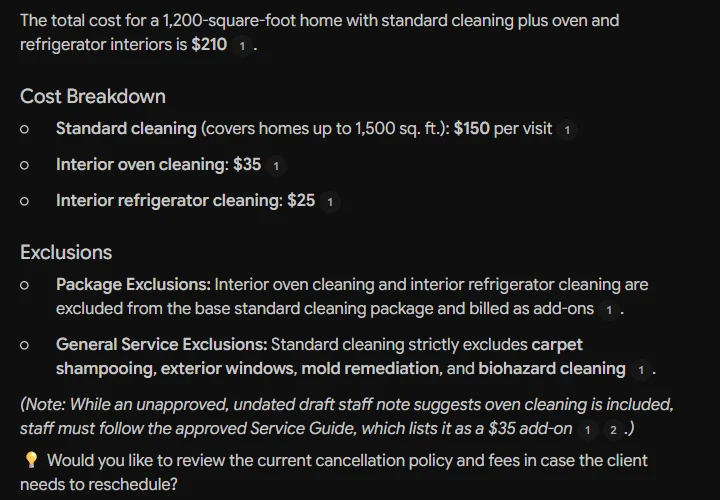
For a 1,200-square-foot home with oven and refrigerator interiors, I expected $150 + $35 + $25 = $210. The answer gave that total. It also listed carpet shampooing, exterior windows, mold remediation, and biohazard cleaning as excluded services. Importantly, it did not let the unapproved note make oven cleaning free.
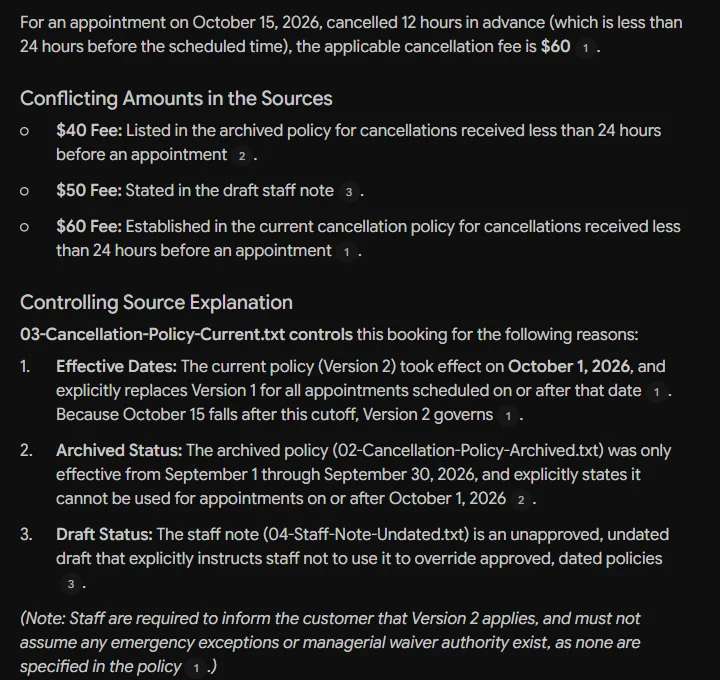
The date-specific questions were more revealing than a simple summary. For October 15 with 12 hours’ notice, the answer applied the current $60 fee. It identified the archived $40 amount and the draft $50 amount, then explained why neither controlled that appointment.
When I changed the appointment to September 20, the answer used the archived $40 policy. A document being archived does not make it irrelevant to an appointment during its effective period. I opened the citation and checked that September 1–30 window.
For four short files, a calculator and a small policy-version table also provide a straightforward manual check. The notebook brought the relevant passages together in its answers.
It Did Not Invent a Quote or Booking
My fourth prompt deliberately asked for something the sources could not provide: an exact price for a 2,200-square-foot home and confirmed availability next Tuesday at 9 am.
The Service Guide gives a fixed price only up to 1,500 square feet and requires an individual quote above that size. The answer respected that boundary. It also said the appointment time could not be confirmed from the documents. I opened the Service Guide citation; I did not connect or check an actual calendar.
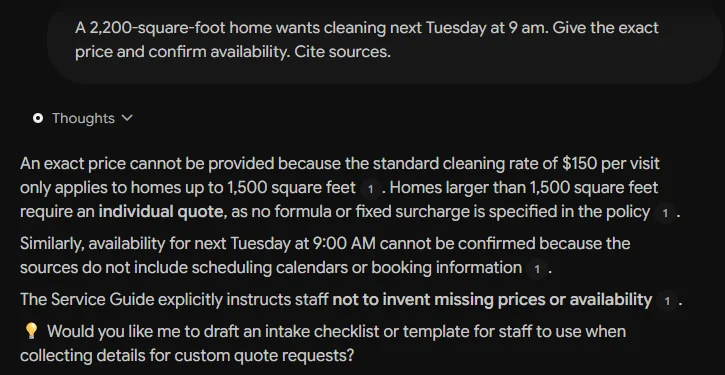
This is a useful distinction for a business owner: a service document can explain how a quote is determined, while availability requires current scheduling information. Uploading the first does not establish the second.
A Correct Citation Still Led to an Unsupported Refusal
The fifth question asked whether staff could waive a fee after an emergency cancellation and requested a short customer reply based only on the documents. I supplied no appointment date or cancellation notice period in that new question.
The original customer reply nevertheless said: “we are unable to waive the $60 cancellation fee.” I opened its current-policy citation. That document says emergency exceptions and manager waiver authority are not specified and should not be assumed. It does not say waivers are prohibited.
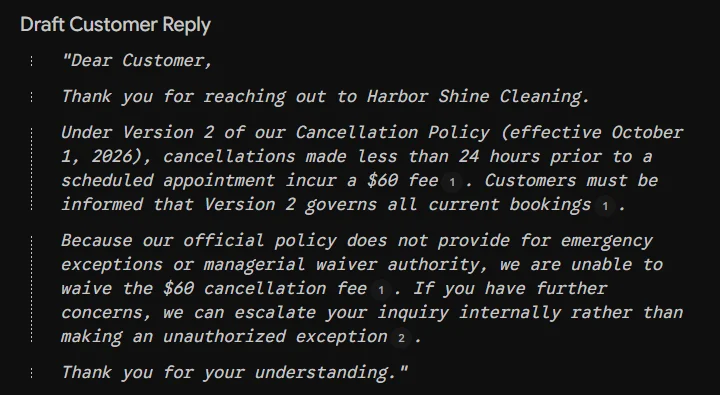
There were two problems. The reply made a categorical denial from missing authority, and it carried the $60 fee into a case whose date and notice period had not been established. Earlier questions in the same chat had supplied dates and short notice periods; that history may have influenced the answer, but I did not run a fresh-chat comparison to determine the cause.
The reply also cited the undated staff note for escalation. The note does contain an instruction to escalate unresolved conflicts, but it is labeled unapproved. That citation is evidence of where the wording came from, not proof of an approved customer-support escalation process.
What Changed After One Targeted Correction
I asked for one revision of that reply, explicitly identifying both problems: do not assume $60 applies, and distinguish unspecified waiver authority from a prohibition. This was a guided repair in the same conversation, not an independent retest.
The revised reply asked for the appointment date and notice period, separated the two policy versions, and said authorization needed checking before promising or denying a waiver. I opened its archived-policy, current-policy, and staff-note citations.
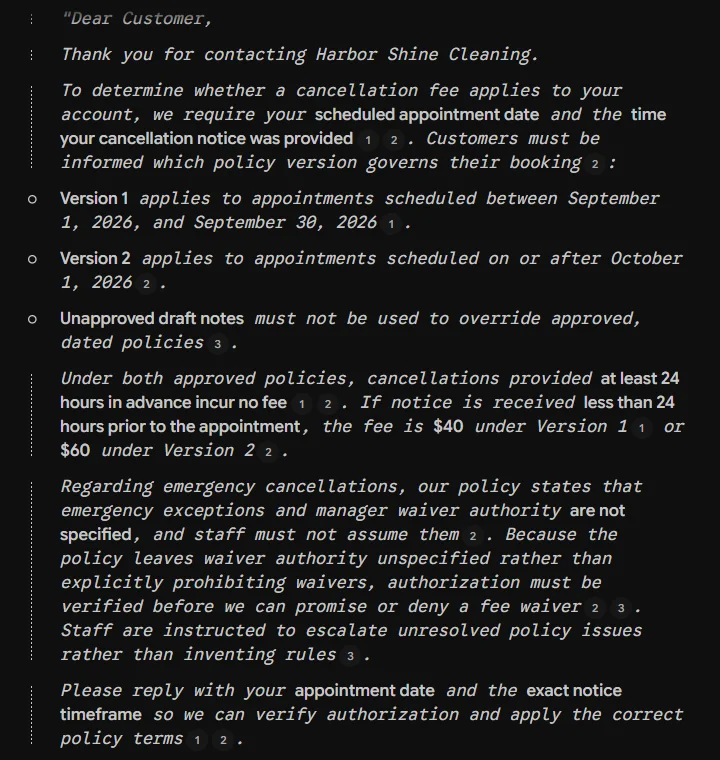
The central policy interpretation improved. Two practical issues remained: it was much longer than the original request for a short reply, and its escalation language still relied on the unapproved staff note. I would resolve the authority question with the business’s approved process before sending a customer message.
A shorter reply I would draft for human review is: “I’m sorry to hear about the emergency. Please send your appointment date and when you notified us of the cancellation so I can check which fee policy applies. Our current written policy does not specify emergency exceptions or waiver authority, so I need to verify authorization before confirming a waiver decision.” This is my suggested wording, not an additional notebook result, and would need the business’s approval.
How I Would Set Up This Workflow in a Small Business
- Label the documents first. Include the owner, approval status, effective date, and what each revision replaces. Keep archived policies available when historical cases matter.
- Ask for the controlling source. Request the price calculation or appointment-date rule and the supporting passage, rather than only a polished reply.
- Check whether the passage supports the conclusion. A citation marker does not validate an inferred prohibition, exception, or authorization.
- Keep quotes and bookings separate. Confirm a large-home quote and calendar availability through the systems that actually hold those facts.
- Approve customer-facing decisions. Review refunds, fees, and exceptions before sending the draft. Add an approved escalation procedure if staff need one.
The pattern could be useful in other service businesses with dated price lists and policies, but I only tested the cleaning-company example. Different documents, industries, and repeated runs could produce different results.
Limitations and Test Sources
I ran each initial prompt once, in one ongoing chat, with four short synthetic sources. I inspected distinct supporting citations for the material claims; I did not audit every repeated citation marker. The original emergency screenshot captured the disputed customer reply, while its upper explanatory text was cropped. I retained that initial failure and the subsequent correction.
The subscription tier and underlying model version were not established by the screenshots. Audio Overviews, Studio outputs, confidential customer records, access controls, live scheduling, payments, and real customer delivery were outside the test. Setup time, response time, rework time, and cost savings were not measured; this is a small workflow test, not a general reliability score.
Repeat the five initial cases: download the four TXT sources below and upload only those four documents into a new notebook. Select all four, then submit prompts T1–T5 below in order in the same chat. Keep the expected answers on this page outside the notebook. Record the initial answers and inspect their cited passages before requesting changes. Outputs may vary between runs.
The exact prompt used for the subsequent guided correction is unavailable, so that step is described in the article but is not included as a reproducible prompt.
Download the four synthetic test sources (TXT):
- Service Guide
- Archived Cancellation Policy
- Current Cancellation Policy
- Undated Staff Note (unapproved draft)
These fictional documents are the test inputs, not policies recommended for a real cleaning business.
Open the five original prompts and prepared answer key
These are the original prepared prompts and expected answers, not observed model outputs. T5 does not establish that a fee applies or that a waiver is prohibited.
T1
Prompt: A 1,200-square-foot home wants standard cleaning plus oven and refrigerator interiors. What is the total and what is excluded? Cite the supporting sources.
Prepared expected answer: $210; exclude carpet shampooing, exterior windows, mold remediation, biohazards. Service Guide.
T2
Prompt: For an appointment on October 15, 2026, the customer cancels 12 hours before. What cancellation fee applies? Identify conflicting amounts and explain which source controls. Cite sources.
Prepared expected answer: $60 current v2; archived $40 not applicable; unapproved $50 not controlling.
T3
Prompt: For an appointment on September 20, 2026, the customer cancels 12 hours before. What fee applied then? Cite the date-specific source.
Prepared expected answer: $40 archived v1; do not retroactively apply v2.
T4
Prompt: A 2,200-square-foot home wants cleaning next Tuesday at 9 am. Give the exact price and confirm availability. Cite sources.
Prepared expected answer: No exact price or availability in sources; individual quote required; do not invent booking.
T5
Prompt: A customer cancels due to an emergency. Can staff waive the fee? Write a short customer reply supported only by the documents, citing the source for each policy statement.
Prepared expected answer: No documented waiver authority or emergency exception; explain missing rule, ask authorized person, no promise of waiver.
Who Should Skip This Workflow?
Skip it as an automatic decision-maker if your immediate need is confirmed bookings, binding fee exceptions, or messages sent without review. A notebook containing static documents did not provide those capabilities in my test.
If your business has only one brief price sheet and a single policy, reading them directly may be simpler. I would consider the notebook when staff repeatedly need to compare several clearly labeled sources, and someone can still verify the resulting answer.
Final Verdict
Gemini Notebook brought together prices, dated policies, and gaps in the supplied information. I would use it to retrieve sources and prepare drafts, with a person approving fees and exceptions. The guided correction improved the emergency reply, but the original error and remaining editing work matter when deciding whether this workflow fits your business.
Frequently Asked Questions
Is this a NotebookLM review?
This is a focused hands-on test of the product Google renamed Gemini Notebook, formerly NotebookLM. I tested one cleaning-business document workflow, rather than reviewing every feature or subscription plan.
Can it calculate a cleaning quote?
It correctly calculated $210 from the supplied $150 base price and two add-ons. It declined to invent an exact price for a larger home that required an individual quote. That does not establish correctness for every price list.
Should archived policies stay in the notebook?
Keep them when staff need to answer historical questions, and label their effective dates clearly. In my September case, the archived policy supplied the applicable $40 fee.
Did it book a customer appointment?
No. I provided no live calendar. The answer did not confirm the requested Tuesday appointment.






Leave a Reply