
Introduction
AI tools for small law firms are easy to recommend in a list. They are much harder to judge when you give them realistic legal-work tasks and deliberately include uncertain facts, missing documents, disputed claims, and jurisdiction-specific questions.
For this hands-on test, I used five AI tools on five different workflows a small U.S. law firm could realistically encounter: contract review, current legal research, client intake, case-timeline organization, and client-update drafting. I used fictional firms, clients, contracts, and disputes throughout. No real client or confidential information was used.
The goal was not to test whether AI can replace a lawyer. It was to see whether each tool could reduce useful work while preserving the distinctions lawyers care about: what is documented, what is only reported, what remains uncertain, what requires jurisdiction-specific review, and what still needs human verification.
Quick Verdict
⚙️ Best for: Small law firms looking for AI assistance with research, contract review, intake, case organization, and drafting.
🧩 Main limitation: Every tool still required attorney review, especially for jurisdiction-specific conclusions, citations, and factual accuracy.
🏆 Overall verdict: There was no single winner. The strongest tool depended on the task.
How I Tested These AI Tools for Small Law Firms
I tested Genie AI, Perplexity, Claude, ChatGPT, and Evatt AI. Instead of asking all five tools the same generic legal question, I assigned each one a task that matched a realistic small-firm workflow.
Before each test, I defined specific traps the tool should avoid. Examples included turning an unverified contract term into a fact, choosing a governing jurisdiction without evidence, treating a claimed debt as definitively owed, inventing a deadline, or reaching a breach conclusion before reviewing the contract.
I evaluated each result on factual discipline, usefulness, legal caution, organization, sources when relevant, and the amount of attorney review still required. These tests are workflow evaluations, not legal advice and not a benchmark of substantive legal competence across every jurisdiction.
Test 1 — Genie AI: Contract Risk Review
Task and prompt
I created a one-page fictional consulting agreement between Oakwood Legal, acting as the client, and Northbridge Consulting LLC. The agreement deliberately contained seven problems, including vague scope, unilateral fee increases, asymmetric termination rights, short-lived confidentiality, unfavorable IP ownership, a blanket liability exclusion, and an ambiguous governing-law clause.
Tested prompt
Review this consulting services agreement from the Client’s perspective. Identify the most important legal and commercial risks, explain why each issue matters, and suggest practical revisions or negotiation points. Prioritize the issues as High, Medium, or Low risk. Do not assume facts that are not stated in the agreement. Flag anything that requires jurisdiction-specific legal review rather than guessing.
What happened
Genie found all seven planted issues. It reported 16 issues overall — 9 High priority, 6 Medium priority, and 1 Low priority — and connected many of them to specific clauses. It also identified additional gaps such as missing payment mechanics, no deliverable-acceptance process, no warranties, no dispute-resolution clause, and no data-protection terms.
The strongest part of the result was its treatment of governing law. The agreement said only that U.S. law applied, without naming a state. Genie explicitly said that the clause was legally ambiguous, that contract law is largely state-based, and that jurisdiction-specific legal advice was required rather than guessing.
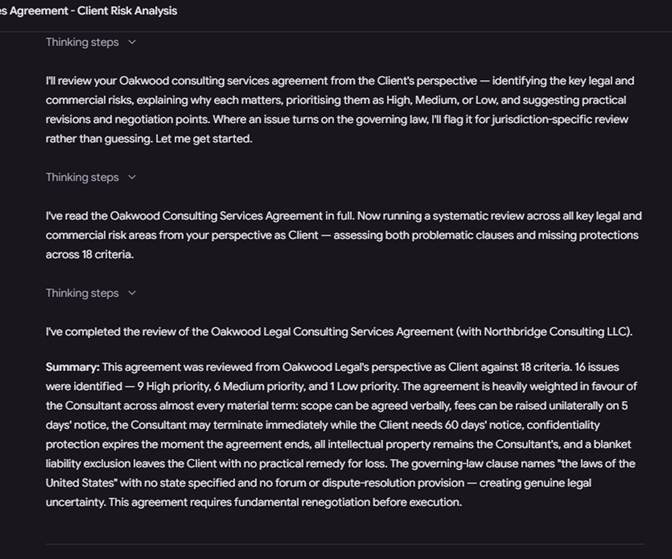
Genie AI summarized 16 issues and surfaced the main planted risks in the fictional consulting agreement.
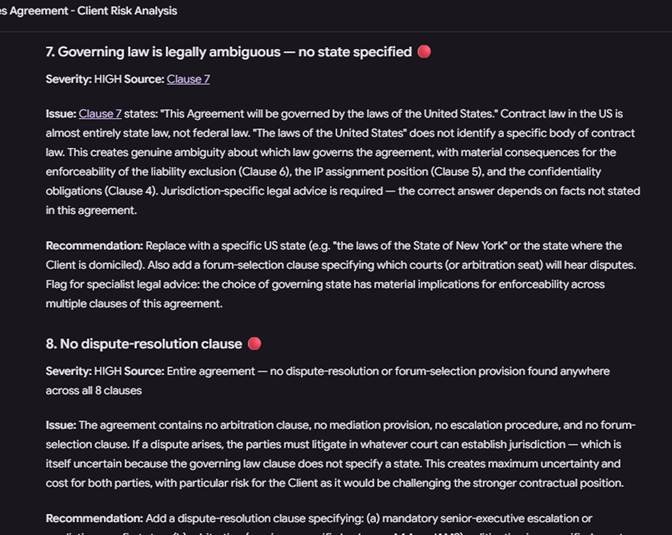
Genie correctly flagged the governing-law clause as jurisdiction-dependent instead of selecting a state on its own.
Where Genie still needed attorney review
The output was strong, but not flawless. One heading said that “verbal agreements are unenforceable,” which is too categorical without jurisdiction and context. Genie also presented some specific negotiation suggestions — such as notice periods, confidentiality durations, and insurance amounts — as practical or market-standard recommendations without supplying sources.
Test 2 — Perplexity: Current Legal Research
Task and prompt
Tested prompt
A small U.S. law firm is conducting preliminary research on the Federal Trade Commission’s Non-Compete Clause Rule. What is the current legal status of the FTC’s rule as of September 2026? Explain the key developments that determined whether the rule can be enforced. Prioritize primary legal and government sources over news articles or blogs, provide citations for the key factual and legal claims, and clearly distinguish nationwide developments from any narrower rulings. Do not provide legal advice. If the current status is uncertain or subject to ongoing litigation, say so explicitly.
What happened
Perplexity gave the correct central status for September 2026: the FTC Non-Compete Clause Rule was not in force and was not enforceable nationwide. It organized the answer chronologically around the 2024 district-court vacatur, the FTC’s 2025 decision to abandon the relevant appeals, and the agency’s 2026 removal of the rule from the Code of Federal Regulations.
It also separated nationwide developments from narrower litigation and noted that state law and case-by-case FTC enforcement still matter. That made the answer useful as a preliminary research map rather than a one-line conclusion.
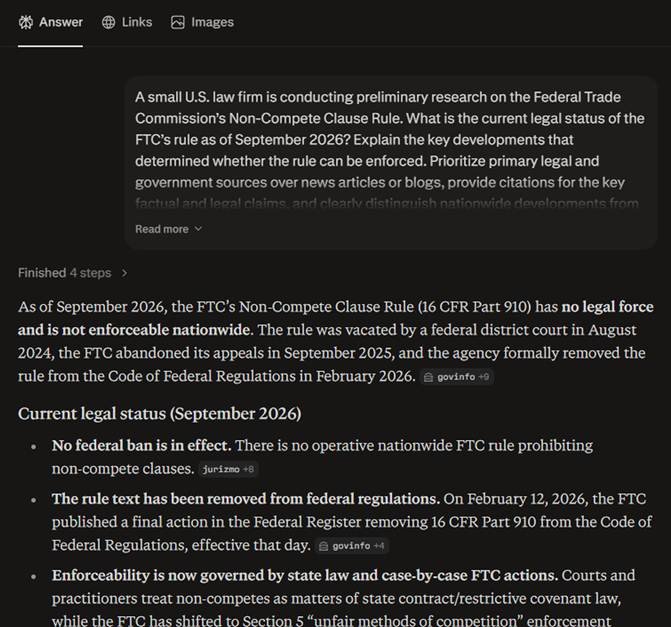
Perplexity clearly stated the current nationwide status and began a dated chronology of the key developments.
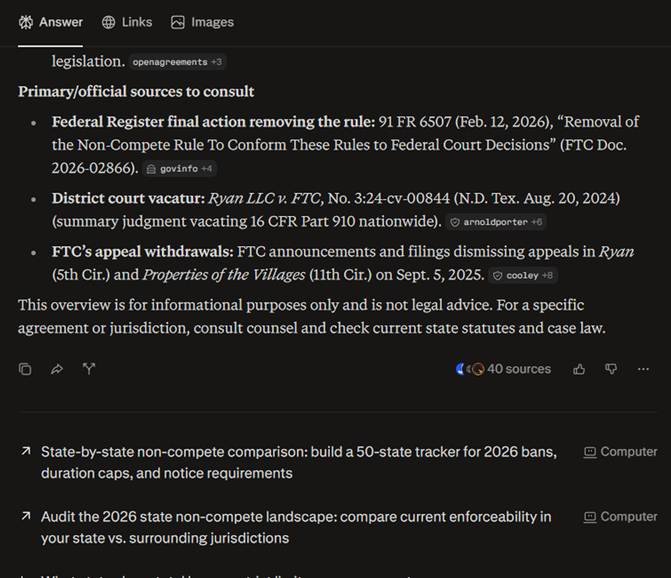
The result ended with primary and official sources to consult and an explicit informational-purpose disclaimer.
Where Perplexity still needed attorney review
The main weakness was source discipline. Although I explicitly asked it to prioritize primary legal and government sources, Perplexity still mixed secondary sources into parts of the reasoning. For legal research, a lawyer should still open the underlying authorities and verify that each proposition is supported by the cited source.
Test 3 — Claude: Client Intake and Issue Spotting
Task and prompt
Tested prompt
You are assisting a small U.S. law firm with preliminary client intake.
A potential client provided the following information:
‘I own a small marketing agency. In March 2026, we signed a six-month agreement with a local retailer to manage its social media accounts for $4,000 per month. They paid March, April, and May. In June they stopped paying, but asked us to keep working because they said cash flow was temporarily tight. We continued through July. On July 18, they emailed saying they were unhappy with engagement results and wanted to end the relationship immediately. They still owe us for June and July. I think the contract requires 30 days’ notice to terminate, but I need to check. They also told me verbally in May that our work was ‘great.’ I have the signed agreement, invoices, emails, and some text messages. I have not sent a formal demand letter. The retailer is in Illinois, but my agency is in Wisconsin. I don’t remember what the contract says about governing law or dispute resolution.’
Create a preliminary client-intake summary for an attorney. Separate:
1. Confirmed facts
2. Potential legal or contractual issues to investigate
3. Important missing information
4. Documents and evidence the attorney should review
5. Suggested next questions for the client
Do not determine who is legally right, do not invent contract terms or missing facts, and do not provide a definitive legal conclusion. Clearly flag anything that depends on reviewing the contract or determining the applicable jurisdiction.
What happened
Claude was particularly good at separating reported facts from unresolved legal questions. It labeled the first section “Confirmed Facts (as reported by client),” which preserved the source of the information instead of making the intake notes sound independently verified.
It did not turn the client’s belief about a 30-day termination provision into a confirmed contract term. It did not automatically choose Illinois or Wisconsin law. It also treated the $8,000 figure as based on the stated monthly rate and scope rather than as an adjudicated debt.
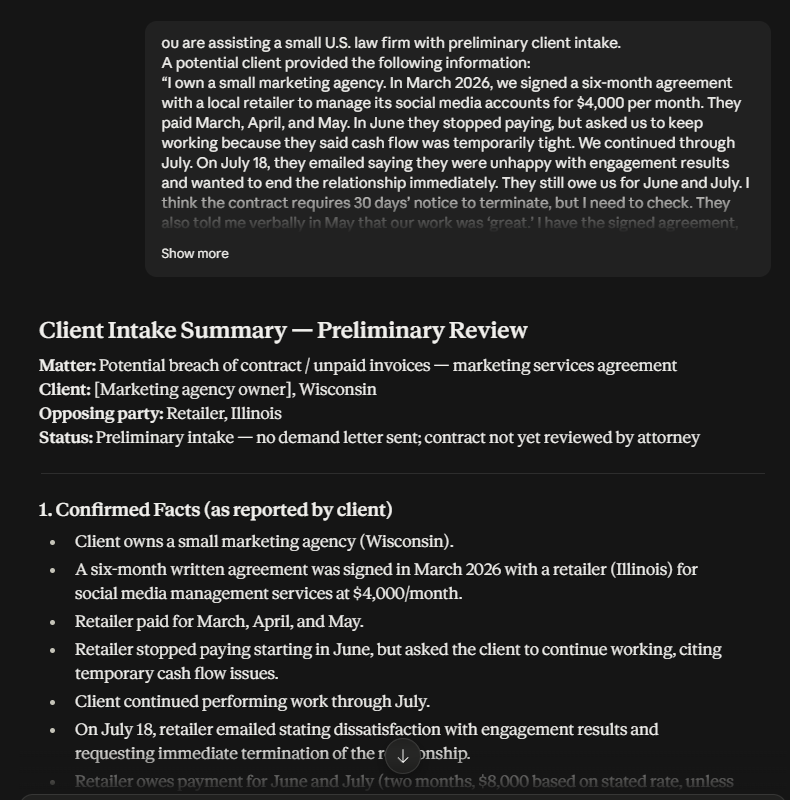
Claude preserved the distinction between the client’s account and contract terms that still required review.
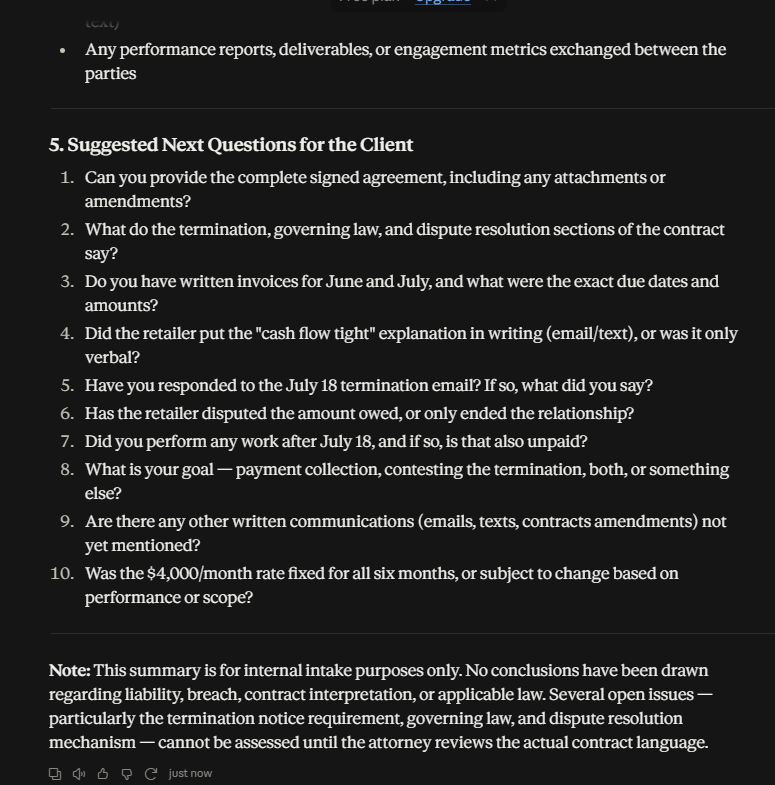
Claude finished with practical follow-up questions and an explicit safeguard against premature legal conclusions.
Where Claude still needed attorney review
Claude also surfaced broader concepts such as waiver, mitigation, and limitations issues. Those can be useful prompts for an attorney, but they go beyond pure intake organization and remain dependent on the contract, facts, and governing law.
Test 4 — ChatGPT: Building a Case Timeline
Task and prompt
Tested prompt
You are assisting a small U.S. law firm with organizing preliminary case information.
The following are messy notes from a client meeting:
– Client says she hired a home renovation contractor sometime in early February 2026.
– Written contract is dated February 6, 2026.
– Contract price: $38,000.
– Client says she paid a $12,000 deposit “the day we signed,” but the bank record has not yet been reviewed.
– Contractor began work on February 17.
– Client remembers being told the project would take about eight weeks, but she is not sure whether that deadline appears in the written contract.
– March 12: client emailed contractor about delays and unfinished electrical work.
– Contractor replied March 13 saying materials had been delayed.
– Client says contractor verbally promised on March 20 to finish “within three weeks.” No written confirmation has been found yet.
– April 4: contractor sent an invoice for $10,000.
– Client says she paid it on April 7. Payment record still needs verification.
– April 15: client photographed unfinished kitchen and exposed wiring.
– Client says contractor stopped coming to the property “around April 20,” but she does not know the exact last day workers were there.
– April 28: client emailed asking when work would resume.
– May 2: contractor replied that the project was on hold because of a dispute over additional work. Client disputes agreeing to any additional work.
– May 10: client hired another contractor to inspect the property.
– The inspection report is dated May 12 and identifies incomplete work and several items that may require correction.
– Client has not provided the original contract, bank records, photographs, April 4 invoice, emails, or inspection report to the attorney yet.
Create an attorney-ready preliminary case timeline.
For each entry:
– Give the date, or clearly label it approximate/unknown.
– Describe what occurred.
– Label the information as Documented, Client-reported, or Needs verification.
– Identify the supporting document or evidence, if one is mentioned.
After the timeline, create separate sections for:
1. Key factual conflicts or uncertainties
2. Missing documents/evidence
3. Dates or claims that should not be treated as established facts yet
Do not determine whether either party breached the contract, do not assume that an oral statement changed the written agreement, do not invent missing dates or contract terms, and do not provide legal advice.
What happened
ChatGPT handled the evidence-status problem very well. Before the timeline, it added an important qualification: “Documented” meant a document was reported to exist, not that the document had already been reviewed or authenticated. That distinction is exactly the kind of detail that can prevent an intake timeline from becoming more certain than the underlying evidence.
The timeline kept “early February” and “around April 20” approximate, treated the deposit and later payment as needing verification, did not assume the eight-week timeframe was a written contract term, and did not treat the alleged March 20 oral promise as a modification of the agreement.
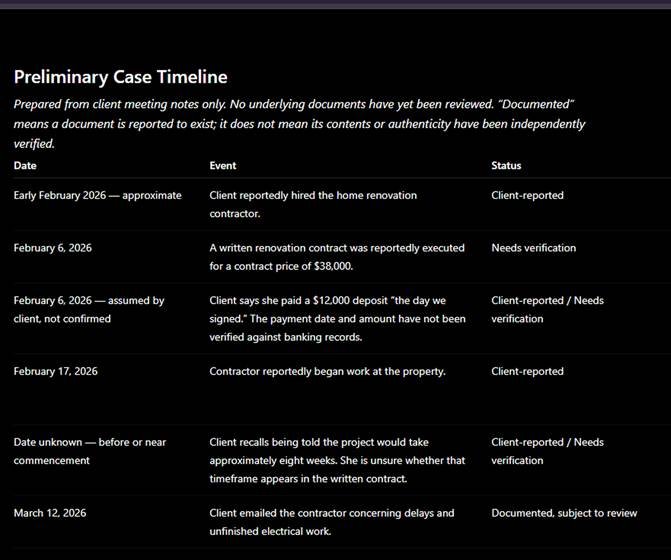
ChatGPT organized messy client notes into a timeline while distinguishing client-reported facts from items that still needed verification.
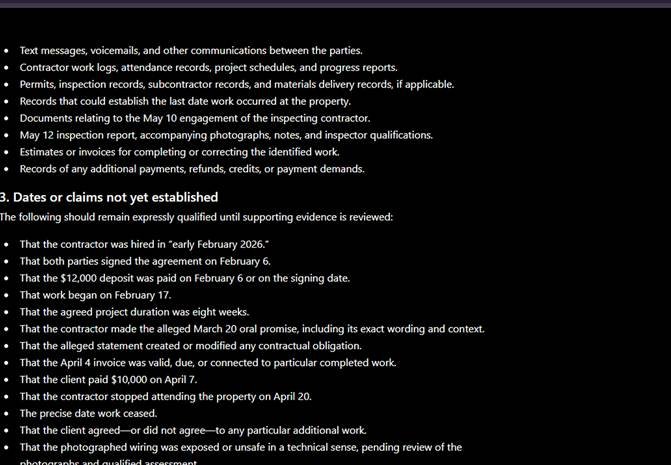
The final safeguard section explicitly listed dates and claims that should not yet be treated as established facts.
Where ChatGPT still needed attorney review
The result was longer than a quick-reference timeline needed to be, and it suggested some additional evidence sources that were not mentioned in the original notes. Those suggestions were reasonable investigative ideas, but a small firm might want a shorter version for day-to-day case use.
Test 5 — Evatt AI: Drafting a Client Update
Task and prompt
Tested prompt
You are assisting Oakwood Legal with drafting a client update based only on the information below.
The client, Greenfield Design LLC, claims that a former business customer owes $15,000 under a services agreement. Oakwood Legal sent a demand letter on August 20, 2026. On September 3, the other party responded by email denying that the full amount is owed and alleging that some services were incomplete. The response did not include supporting documents. The client says all contracted work was completed, but the attorney has not yet reviewed all project records. No lawsuit has been filed, no settlement has been reached, and no court deadline currently applies.
Draft a concise, professional email updating the client.
The email should:
– explain what happened;
– distinguish the other party’s position from established facts;
– explain what information or documents still need review;
– describe reasonable next steps without promising a particular outcome;
– avoid stating that $15,000 is definitively owed;
– avoid inventing deadlines, settlement offers, court proceedings, contract terms, or facts not provided.
Do not provide a definitive legal conclusion.
What happened
Evatt AI was configured to the USA jurisdiction for this test. The client email itself was disciplined. It referred to “the $15,000 you claim is owed,” described incomplete services as the former customer’s allegation, and said the firm still needed to review the underlying project records, deliverables, and communications.
It also preserved the procedural limits supplied in the prompt: no lawsuit had been filed, no settlement had been reached, and no court deadline currently applied. It avoided promising an outcome and said a definitive conclusion could not be made until the evidentiary review was complete.
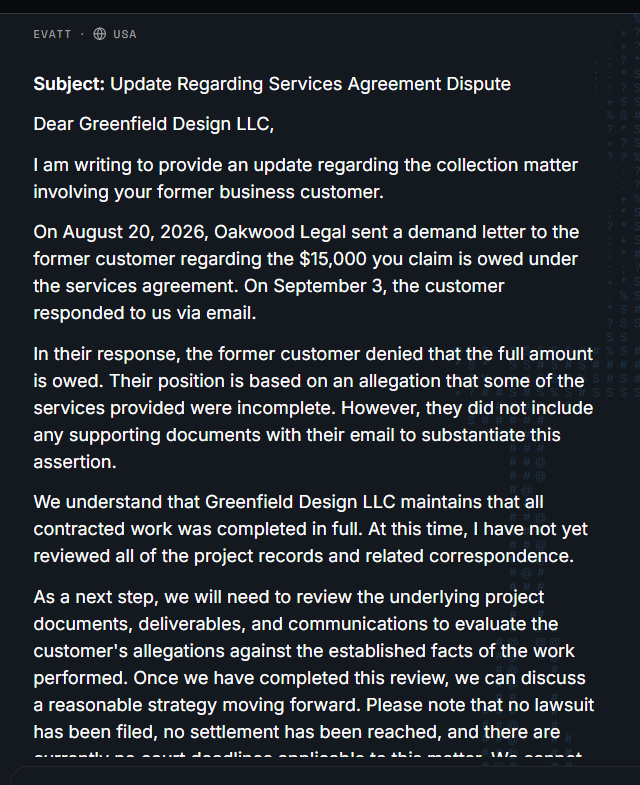
Evatt kept the $15,000 as the client’s claim and distinguished the opposing party’s allegation from established facts.
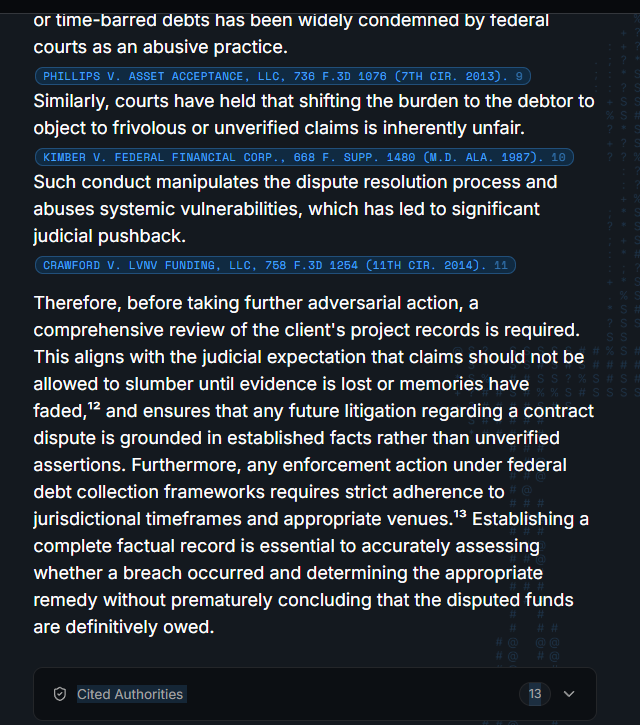
Evatt went well beyond the requested concise email, adding an internal memorandum with 13 cited authorities.
Where Evatt still needed attorney review
The biggest problem was scope. After producing the concise client email, Evatt generated a lengthy “Internal Legal Memorandum: Contextual Framework for Dispute Resolution” with 13 cited authorities and additional discussion of contract disputes and debt-collection frameworks.
That extra material may sometimes be useful, but it was not requested. In a small firm, unnecessary analysis can create more review work rather than less. The email showed good factual discipline; the overall response showed weaker scope discipline.
Side-by-Side Results
| Tool | Task | Result | Main limitation |
|---|
| Genie AI | Contract risk review | Strong | One overly categorical legal statement |
| Perplexity | Current legal research | Strong | Mixed primary and secondary sources |
| Claude | Client intake | Strong | Some broader issue spotting |
| ChatGPT | Case timeline | Strong | More verbose than necessary |
| Evatt AI | Client update drafting | Strong | Expanded far beyond requested scope |
Which AI Tool Is Best for a Small Law Firm?
My tests did not produce one defensible overall winner, because the tools were strongest in different workflows.
- Contract review: Genie AI stood out for structured risk spotting, clause-level analysis, and negotiation suggestions.
- Current legal research: Perplexity was strong at building a current, cited research map, but primary authorities still need verification.
- Messy client intake: Claude was especially good at separating reported facts, missing information, and questions that depend on the contract or jurisdiction.
- Case organization and timelines: ChatGPT was strong at preserving uncertainty while turning messy notes into an attorney-ready structure.
- Legal-specific drafting: Evatt AI produced a careful client update, but its tendency to expand beyond the requested scope increased the review burden.
For a small firm, that suggests a workflow-first approach: choose the tool for the job you actually need to improve rather than assuming one AI platform should handle every legal task.
What Small Law Firms Should Not Delegate Blindly to AI
Across all five tests, the useful pattern was the same: AI could organize, surface, draft, and research, but the attorney still had to control the legal judgment.
- Final legal conclusions, especially when governing law or jurisdiction is unresolved.
- Citation accuracy and the proposition each authority actually supports.
- Contract interpretation when the underlying document has not been reviewed.
- Client-facing conclusions based on disputed or incomplete facts.
- Confidential client information before the firm has reviewed the tool’s privacy, security, retention, and professional-responsibility implications.
Tools I Tried but Couldn’t Fully Test
Clio Work
I attempted to activate a Clio Work trial, but the signup flow displayed a message that Clio Work was not available in my testing region. Because the article focuses on U.S. small law firms, that does not mean Clio Work is unavailable to U.S. firms. It means I could not honestly count it as a hands-on test from my location.
Paxton AI
I also reached Paxton AI’s seven-day trial checkout. Access required a payment card and showed a post-trial charge, plus a small preauthorization hold. I chose not to enter a card solely to complete an editorial test, so Paxton is not counted among the five hands-on tools.
These exclusions matter. A tool should not appear in an “I tested” list unless I actually completed a meaningful task with it.
Final Verdict: AI Tools for Small Law Firms
AI tools can already remove meaningful administrative and analytical work from a small law firm, but these five tests showed that usefulness depends heavily on the task.
Genie AI was strong at structured contract review. Perplexity created a useful current-research map. Claude handled messy intake with excellent factual caution. ChatGPT turned uncertain notes into a disciplined case timeline. Evatt AI drafted a careful client update but generated far more legal analysis than I asked for.
The bigger lesson is not that one of these tools should become the firm’s “AI lawyer.” It is that small firms can use AI selectively to reduce the time spent organizing information, preparing first drafts, spotting issues, and mapping research — while keeping legal conclusions, source verification, confidentiality decisions, and client-facing judgment under attorney control.
For small firms, that workflow-first approach is more realistic than searching for a single AI tool that does everything.
Sources and Test Notes
FTC official sources used to verify the Perplexity test:
FTC — Noncompete Rule — current rule status and enforcement history
All five hands-on scenarios and documents were fictional and created for testing. Screenshots in this article are evidence from the actual tests described above.
Official tool websites: Genie AI · Perplexity · Claude · ChatGPT · Evatt AI
Frequently Asked Questions
Can AI replace a lawyer’s review?
No. AI can support research, drafting, organization, and issue spotting, but a qualified professional must review work that affects legal advice, clients, or filings.
What does this article evaluate?
It evaluates practical AI workflows for small law firms and focuses on observed outputs, limitations, and review requirements rather than presenting legal advice.
How should a law firm handle confidential information?
Use approved accounts and policies, share only the minimum necessary information, and anonymize or remove sensitive details whenever possible.
Are the test results universal?
No. Results can change with the prompt, model version, plan, jurisdiction, and the firm’s review process.
Leave a Reply